
How Many Sprays of Cologne to Use: Start With One
This post contains affiliate links. As an Amazon Associate, we earn from qualifying purchases.
To work out how many sprays of cologne to use, start with one light spray on a pulse point the maker recommends, let it settle, then judge before adding a second. Four sprays isn’t a universal standard, and a spray isn’t a consistent unit from one bottle to the next.
That gap between one atomizer and the next is why a copied answer to how many sprays of cologne to use keeps letting you down. A count you learned on a bottle you’ve owned for a year tells you almost nothing about the one you just unboxed. The formula shifts the dose, and the room shifts what’s acceptable.
What follows is a short testing routine, the placement that actually earns its keep, and the settings that change the answer more than the fragrance does.
Key Takeaways
- Start with one light spray on a maker-recommended pulse point, let it settle, then decide whether to add more.
- Four sprays isn’t a standard. It’s a habit borrowed from bottles with different atomizers and different formulas.
- A spray isn’t a fixed volume, so a count that reads right on one bottle can read twice as loud on the next.
- The room overrides the bottle. Shared indoor space and fragrance-free policies beat any number you like.
- Judge from a distance, not with your nose pressed to your wrist, and ask someone you trust.
Is Four Sprays Actually the Standard?
Four shows up in many popular guides, though Scented Chemistry rejects it as a universal standard. It gets repeated because it’s easy to repeat, and nobody measured it.
An atomizer is a mechanical pump, and pumps vary. A full press from one delivers a larger dose than a press from another, so a count learned on a single fragrance does not transfer. Concentration compounds the problem: the same press from an eau de parfum carries more fragrance material than a press from an eau de toilette.
Scented Chemistry is blunt about this. Four sprays isn’t a universal standard, and the better move is to follow the directions on your own bottle and adjust lightly for where you’re wearing it. Dior’s Sauvage EDP directions, for example, name pulse points such as the wrists and neck. That’s the maker telling you where, which is more specific than any blog telling you how many.
The cologne concentration in the bottle changes how much material lands with each press. Switching from an EDT to an EDP without changing your count can make a familiar fragrance feel like a stranger. Scented Chemistry makes the same point: reassess the amount when the concentration or the atomizer changes, even if the name on the label hasn’t.
Spray distance matters too. Hold the bottle closer and the same press lands wetter and more concentrated on a smaller patch of skin. A little spray distance discipline keeps your count comparable from one morning to the next.
Which is the whole problem with counting. You’re counting presses, not liquid.
How Many Sprays of Cologne to Use on a First Wear
Early on I put far too many pumps of a heavy woody cologne on before a day indoors, convinced that more meant more presence. By lunch I couldn’t stand my own sleeve, and I’ve kept to a much smaller number ever since. The lesson was that I never checked in between presses.
Here’s the routine I use now.
Before you start: Keep fragrance away from eyes, lips and irritated skin. If a product causes a skin reaction, the American Academy of Dermatology advises washing it off gently and stopping its use, then seeking medical advice if the reaction persists.
- Spray once on a pulse point the maker recommends, then stop. Skipping the stop is how a test turns into a commitment.
- Let it dry without rubbing. The popular explanation that rubbing breaks fragrance molecules is misleading, so don’t use it to explain why one scent fades faster than another.
- Wait before you judge. The opening is the loudest part of the wear and the least representative of it.
- Add a second press only if the first has gone quiet at the distance you’d normally stand from someone.
- Note what you did. Two presses on this bottle, one on that one. Without the note you’ll re-argue the same decision next month.
The first press lands cold and wet on the inside of your wrist, and the alcohol reaches your nose before the fragrance does. That first moment tells you almost nothing.
For a first wear, do it at home. Scented Chemistry recommends a light application at home before wearing a new scent around other people, which is the cheapest test available and the one most people skip.
Where Should You Spray Cologne?
Wrists and neck are the common suggestions, and you don’t need to spray every pulse point. One or two areas covers most daily wear.
Wrists, Neck, and the Points You Can Skip
A wrist is handy when you’re sampling because you can check it later. It’s also the worst place to test longevity, because handwashing takes the fragrance off. If your where to apply cologne plan starts and ends at the wrist, you’re measuring your hand-washing habit, not the bottle.
Start with what the maker suggests. Dior’s Sauvage EDP directions point to pulse points such as the wrists and neck, and that’s a reasonable default for most spray fragrances.
Clothing needs its own rules. Use fragrance on fabric only as directed, check the care label, and test a hidden area first for marks. A spray that’s invisible on skin can leave a ring on silk.
Easy to miss: Handwashing may remove fragrance from a wrist, so a wrist test can’t tell you how long a bottle actually lasts.
The Room Decides More Than the Bottle Does
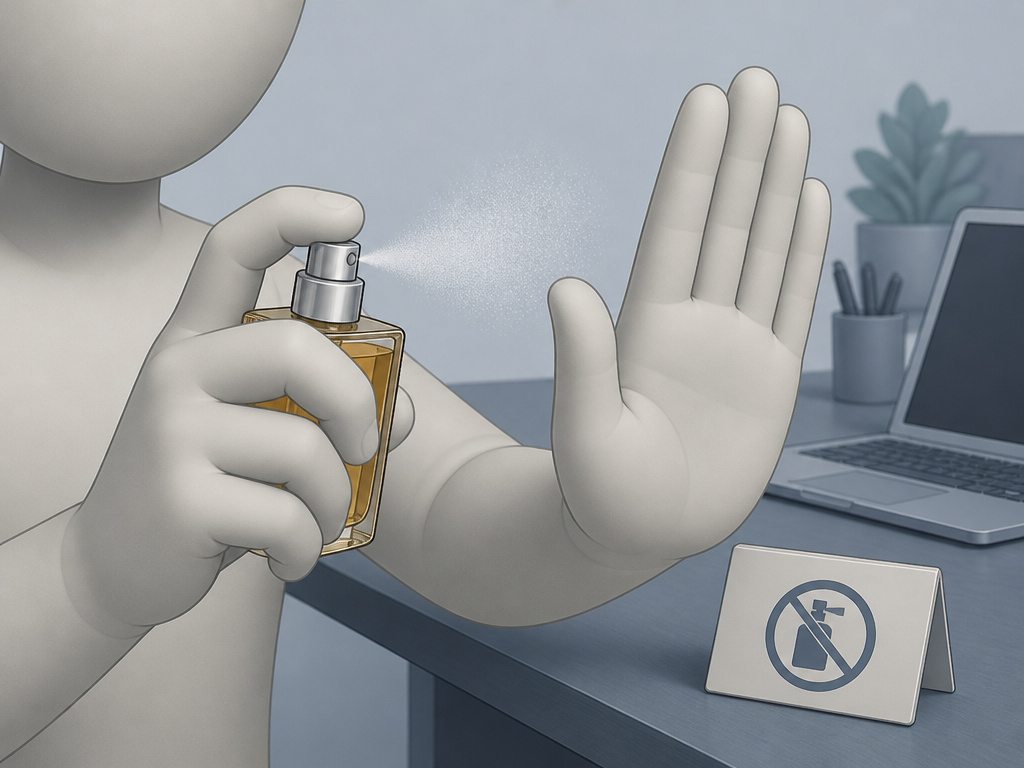
A fragrance that reads as restrained in a cold kitchen can clear a small meeting room. The setting changes the answer more than the fragrance does, and it changes it faster.
| Situation | Starting approach |
|---|---|
| First time wearing a scent | Light application at home, before other people |
| Shared indoor space | Keep it restrained, and respect any fragrance-free policy |
| Evening out | Check what’s left from earlier before adding anything |
| New concentration or atomizer | Reassess the amount, even if the name is familiar |
Office, Dinner, and the Fragrance-Free Desk
Shared indoor space is where counts go wrong most often. Scented Chemistry’s guidance is to keep the application restrained and respect any fragrance-free policy, which means the policy beats your preference every time. If your building has one, the correct number is zero.
An office fragrance choice matters less than the amount you apply in an open-plan room. A close-wearing scent applied lightly beats a bold one applied heavily, every day of the week.
Evenings out get their own rule. Judge what remains from earlier before adding another application. If you can still catch it at the distance you’d normally sit from someone, you don’t need a top-up.
Summer is the other setting that resets the number. Heat changes how a fragrance projects and how quickly it burns off, which is why cologne in hot weather calls for a lighter hand than the same bottle in November.
Where this goes sideways: Adding a second and third press because you stopped smelling it. Your nose adapts to a constant smell. The room doesn’t.
Why More Sprays Don’t Add More Wear
Spraying more locations isn’t a reliable way to guarantee longer wear. It’s a reliable way to guarantee that more people notice you.
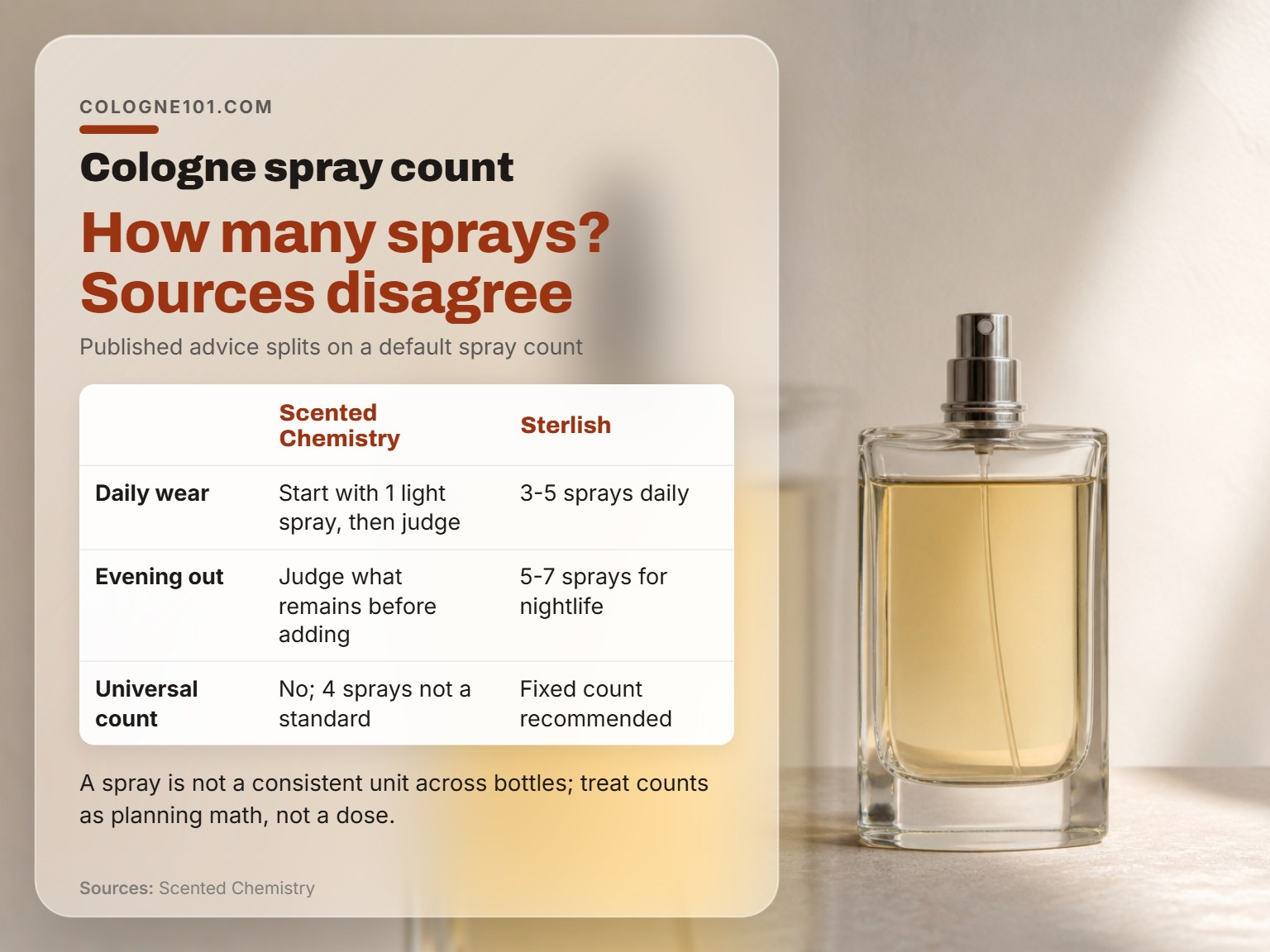
A spray isn’t a consistent measuring unit across bottles, so a count that reads right on one bottle can read twice as loud on the next. That’s an estimate rather than a measured tolerance, and no manufacturer publishes a per-spray volume. If you’re working from a sprays in a 10ml decant figure, treat it as planning math, not a dose.
Here’s where the published advice splits, and it’s worth seeing the split rather than picking a side.
| Source | Position on spray count | What it leaves out |
|---|---|---|
| Scented Chemistry | Start with one light spray, then judge | Assumes you’ll actually wait before adding |
| Sterlish (aggregator) | 3-5 daily, 5-7 for nightlife | No bottle, atomizer or room detail |
| Common guide consensus | 2-4 sprays on pulse points | Treats a spray as a fixed unit of liquid |
Three positions, three different answers. Scented Chemistry’s one-spray starting point and Sterlish’s five-to-seven for a bar are opposites, and both are being stated with confidence. Treat that as a sign the question doesn’t have a universal answer.
The Rubbing Question
Many popular guides still assert that rubbing your wrists together breaks fragrance molecules, while Scented Chemistry calls that explanation misleading. Scented Chemistry calls that explanation misleading. The rubbing does move the liquid around and speeds the alcohol off your skin, which is reason enough to leave it alone, but the molecular story doesn’t hold up.
If you want to rub cologne in or not, the practical answer is to let it dry. It costs you nothing.
If you can smell your own cologne at the distance you’d normally sit from someone, you’re already past the point where adding more helps.
Solids fixed this for me by accident. I swipe a fingertip across the tin once, dab it on each wrist, and I’m done, mostly because a solid doesn’t let me keep pressing a button. The trade-off is real: projection is quiet, and the solids I’ve tried fade to a skin scent fairly quickly, so I reapply at lunch.
I also moisturize before applying, though I’ll be honest that I can’t prove it does much. It’s a habit, not a finding.
If wear time is genuinely your problem, how to make cologne last longer is a better use of your attention than a higher count. And before you reach for a fourth press, the answer to does more cologne last longer is already settled: spraying more cologne adds volume, not duration.
What to Do When You’ve Overdone It
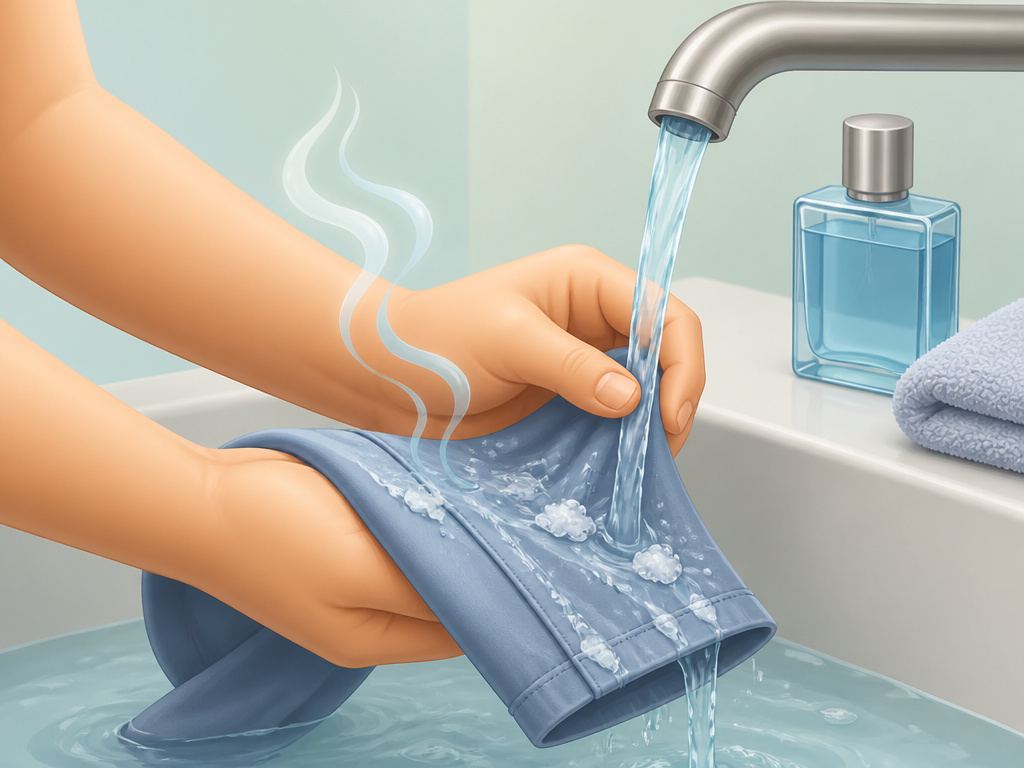
By the time you notice it on your own sleeve, the people around you have been sitting in it for a while. Fix it gently rather than aggressively.
- Wash the application area with your normal skin cleanser and water. Gently.
- Change the sprayed garment if that’s the main source of the scent.
- Don’t add another fragrance to cover it. Layering two mistakes gives you two mistakes.
- Skip the hard scrubbing and household solvents. They damage skin without removing any more fragrance.
If a product is causing a skin reaction rather than just feeling too strong, the American Academy of Dermatology advises washing it off gently, stopping use, and seeking medical advice for a persistent reaction.
Frequently Asked Questions
Is four sprays of cologne too many?
It can be, and it can be too few, which is the problem with the question. Scented Chemistry explicitly rejects four sprays as a universal standard. On a strong eau de parfum in a small office, four is a lot. On a light eau de toilette worn outdoors, four might barely register.
Should I spray cologne on my wrists or my neck?
Both are common suggestions, and Dior’s Sauvage EDP directions name pulse points such as the wrists and neck. You don’t need to hit every pulse point. Pick one or two areas and judge from there. Just remember a wrist is a poor longevity test because handwashing removes the fragrance.
Why can’t I smell my own cologne anymore?
Your nose adapts to a constant smell, so you stop registering it while everyone else still can. That’s the trap. Adding more sprays because you’ve gone nose-blind is how a reasonable application turns into an over-application.
Does rubbing my wrists together ruin the fragrance?
The claim that rubbing breaks fragrance molecules is misleading, per Scented Chemistry. Rubbing does spread the liquid and drive the alcohol off faster, so letting the spray dry on its own is the better habit. The dramatic molecular explanation doesn’t hold up.
How many sprays should I use in a shared office?
Fewer than you would anywhere else, and zero if your workplace has a fragrance-free policy. Scented Chemistry’s guidance is to keep application restrained in shared indoor space and respect any fragrance-free policy. The policy wins over personal preference.
The Bottom Line
If you can smell your own cologne at the distance you’d normally sit from someone, you’re already past the point where another press helps. That’s the threshold I’d hand anyone: judge at the distance you’d actually sit from a colleague, not up close.
One concession worth stating plainly. Everything here assumes a spray bottle with a normal atomizer. If you’re wearing a solid, a rollerball or a splash, the whole counting exercise falls apart, and you’re better off judging by how much product is on your finger than by how many presses you made.
Start with one. Add the second tomorrow if the first disappeared by mid-morning, not if you stopped noticing it by lunch.
