
How Many Sprays Are in a 10ml Decant? The Real Range
This post contains affiliate links. As an Amazon Associate, we earn from qualifying purchases.
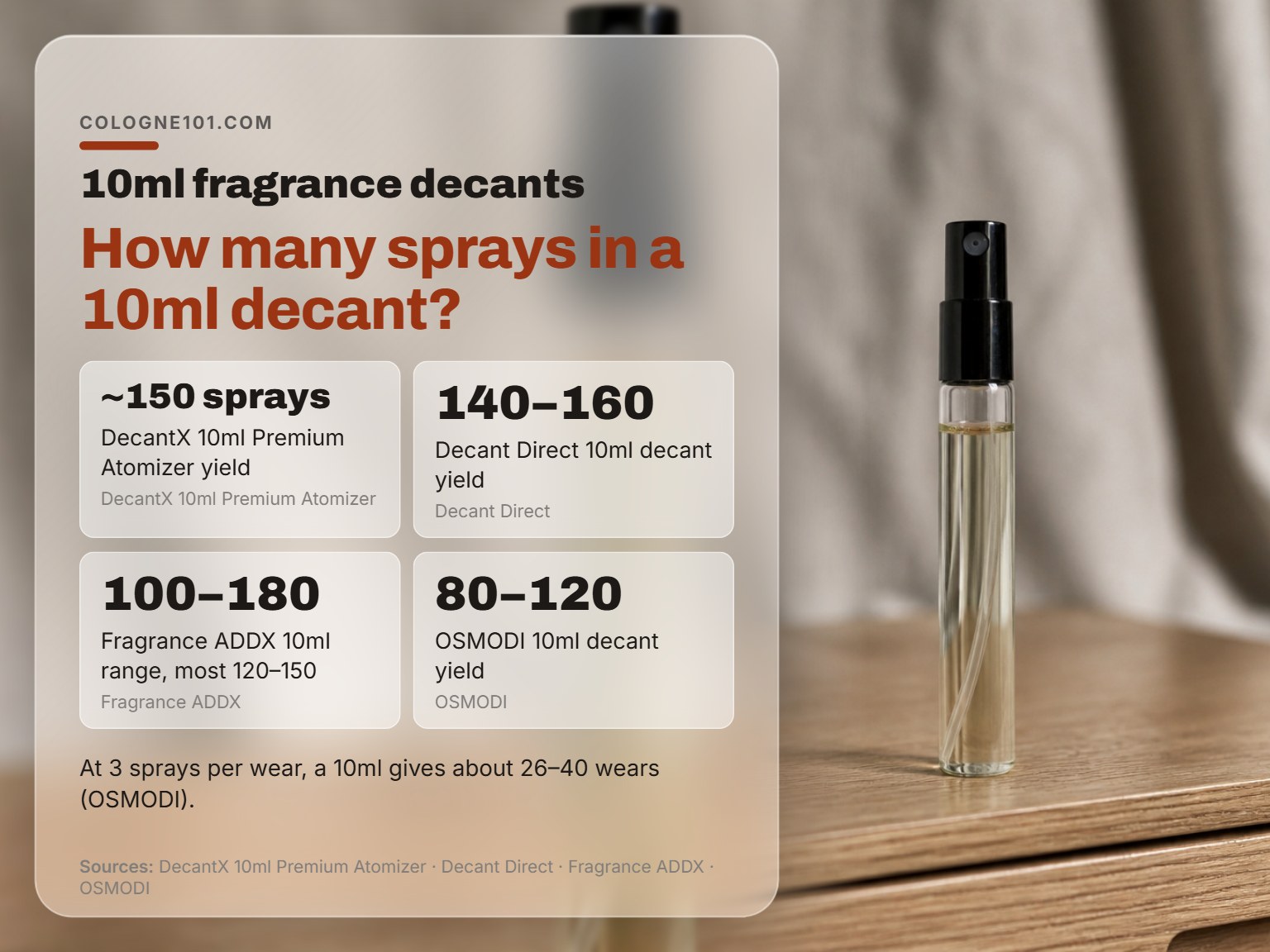
A 10ml decant holds roughly 100 to 150 sprays, but published figures for how many sprays are in a 10ml decant run from 80 (OSMODI) to 160 (Decant Direct). DecantX states about 150 for its own 10ml Premium Atomizer. Atomizer output and press force explain the spread.
That spread is not sloppy record-keeping. A decant atomizer releases somewhere between 0.08 ml and 0.12 ml of liquid per press, and that single variable moves the how many sprays are in a 10ml decant total substantially before anyone factors in how long you hold the button down.
What follows covers the five published ranges and who stands behind each one, the two mechanical reasons they split, and a way to get your own number from the first vial you finish.
Key Takeaways
- Expect 100 to 150 sprays from a 10ml decant, with published ranges running from 80 to 120 (OSMODI) up to 140 to 160 (Decant Direct).
- DecantX publishes about 150 sprays for its 10ml Premium Atomizer.
- OSMODI publishes 80 to 120 sprays, the low end, using an 8 to 12 sprays per ml estimate.
- A visible air gap at the top is intentional and does not mean you were shorted liquid.
- Count your own first vial rather than trusting any table, because press force alone can swing the total.
Which Number Do You Trust: 80 Sprays or 160?
Five retailers, five different answers for the same 10ml vial.
A 10ml decant atomizer delivers between 0.08 ml and 0.12 ml of fragrance per press, according to first-party specifications published by Smellion. Dividing 10 ml by that range gives roughly 83 to 150 sprays. Atomizer nozzle design and press duration set the final figure, and no single number covers every vial.
Here is how the published claims stack up, with the sprays-per-ml figure each one implies.
| Source | Stated sprays for 10ml | Implied sprays per ml |
|---|---|---|
| OSMODI | 80 to 120 | 8 to 12 |
| Fragrance ADDX | 100 to 180, most 120 to 150 | 10 to 15 |
| DecantGems | 100 to 150 | 10 to 15 |
| Decant Direct | 140 to 160 | 14 to 16 |
| DecantX | about 150 | about 15 |
Nobody in that table is lying. DecantX is quoting its own premium atomizer, measured on its own bottles. OSMODI is quoting a general estimate for sprayers it does not manufacture. Fragrance ADDX is honest enough to publish a range so wide it covers both camps, and it names the reason: forum testing has put the figure anywhere from 5 to 16 sprays per ml depending on the pump.
If you are new to the format entirely, learning what a decant is is worth ten minutes before you start counting sprays. The short version is that a seller transfers authentic fragrance from the original bottle into a smaller spray vial, and the vial is not the bottle.
I treat 100 as my planning number. Here is the honest version: I have counted sprays from a 10ml atomizer on three separate occasions and landed between roughly 90 and 120 each time, depending on which atomizer I was holding and how hard I pressed, which is the how many sprays are in a 10ml decant question in practice. That is my data, not a manufacturer’s.
Why Atomizer Output Swings From 8 to 16 Sprays per Milliliter
Ever pressed a decant atomizer and gotten a wet stripe down your wrist instead of a mist?
A fine-mist nozzle breaks the liquid into a light cloud and moves very little volume per press. A wider, wetter nozzle dumps more liquid with each pump. Fragrance ADDX puts the split at roughly 15 sprays per ml for fine-mist atomizers and 8 to 10 per ml for heavy-mist ones.
You can hear the difference before you smell it. A fine atomizer gives a dry hiss and leaves a faint, almost invisible sheen. A wet one lands as a visible damp patch that takes a second or two to sink in.
Fine Mist Versus Wet Spray
Smellion states that fine-mist atomizers common on decants deliver roughly 0.08 to 0.12 ml per spray, while wider-spray bottle caps can exceed that. DecantX’s own figure of about 150 sprays from 10ml works out to roughly 0.067 ml per press, which sits below Smellion’s stated range of 0.08 to 0.12 ml per spray. Read that carefully: DecantX is claiming its atomizer is finer than the benchmark other sellers use for “typical.”
Concentration Changes the Count
DecantGems makes a point that most spray-count tables skip. People tend to use fewer sprays of a more concentrated fragrance. An extrait gets two presses where an eau de parfum gets four, and the atomizer has nothing to do with that decision.
That habit shifts your real-world wear count without changing the spray count in the vial at all. Your 10ml still holds the same number of presses. You just take longer to use them up.
How Long a 10ml Decant Lasts at 3 Sprays a Day
Three sprays a day is a common assumption, though not every retailer uses it, and it is where their answers split hardest.
DecantGems says a 10ml vial lasts roughly 33 to 50 days at three sprays a day, and half that at six. OSMODI frames the same 10ml as 26 to 40 wears at three sprays per wear, or 16 to 24 at five. Fragrance ADDX gives 8 to 12 weeks at four to five wears per week with three sprays each. Those are three different answers to the same question, and the gap between them is roughly 2.5 times.
The reason is that “a wear” and “a day” are not the same unit. OSMODI counts applications. DecantGems counts calendar days. Fragrance ADDX counts weeks of a partial-week routine. If you want the arithmetic behind your own how many sprays of cologne to use routine, start there before you size anything.
| Decant Size | Sprays (Decant Direct) | Days at 3 sprays a day (DecantGems) |
|---|---|---|
| 2ml | 25 to 30 | 7 to 10 |
| 5ml | 65 to 75 | 17 to 25 |
| 10ml | 140 to 160 | 33 to 50 |
Note that the two columns do not agree on rate. Decant Direct’s 2ml figure of 25 to 30 sprays implies a higher sprays-per-ml rate than DecantGems’ day count. DecantGems’ 7 to 10 days at three sprays a day implies a lower sprays-per-ml rate. Same size, different math, both published.
Wear Count Versus Day Count
Fragrance ADDX calls 2ml enough for 5 to 8 full wears at 3 to 4 sprays each. DecantGems calls it 7 to 10 days at three sprays a day. Those land close together, which tells you the 2ml estimates are the most consistent in the industry. The 10ml estimates are where sellers drift.
The Press Force and Dead Volume Nobody Counts
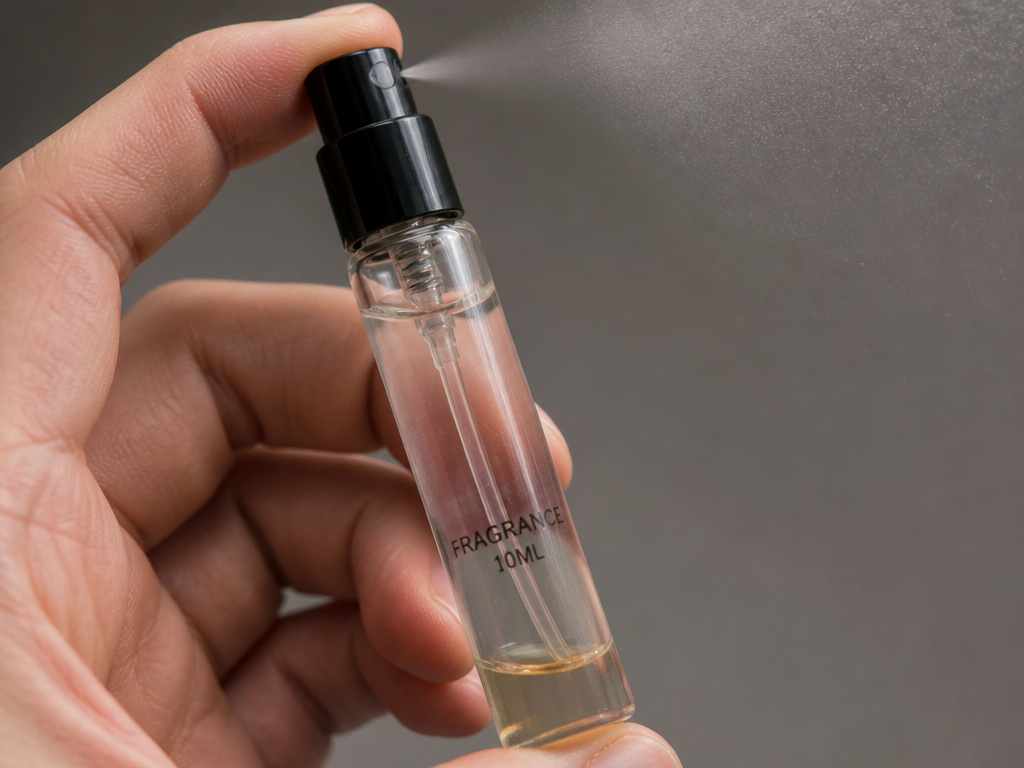
Tip a nearly empty vial and you will hear liquid sloshing around the bottom, well below where the dip tube reaches.
Your 10ml does not deliver 150 usable sprays if the final bit of liquid never leaves the glass.
Press force is the second hidden variable, and here the sources genuinely part ways. DecantGems states a directional rule: a short, light press gives more sprays from the same liquid, and a long, firm press gives fewer. Smellion says personal spraying style affects output but offers no direction, only that distance and duration matter.
Rule of thumb: Fragrance ADDX and DecantGems put the working rule at 10 to 15 sprays per ml, while OSMODI estimates about 8 to 12 sprays per ml and Smellion’s 0.08–0.12 ml per spray implies roughly 8 to 12.5 sprays per ml.
The mechanism behind the press-force question is simple enough. A longer hold keeps the valve open longer, so more liquid travels per press. Shorter presses meter out less. Neither seller disputes that part. They only disagree on whether the effect is big enough to publish a rule about it.
Easy to miss: A visible air gap at the top of a fresh decant is deliberate. DecantX and Decant Direct both state that headspace is left for thermal expansion and pressure changes in transit. Judging your fill by eye will make a correctly filled vial look short.
That air gap trips up first-time buyers constantly. The volume was measured by syringe, not by filling to the brim, and DecantX states plainly that the amount of liquid in each decant is exactly the amount selected.
How to Count Your Own Sprays in One Vial
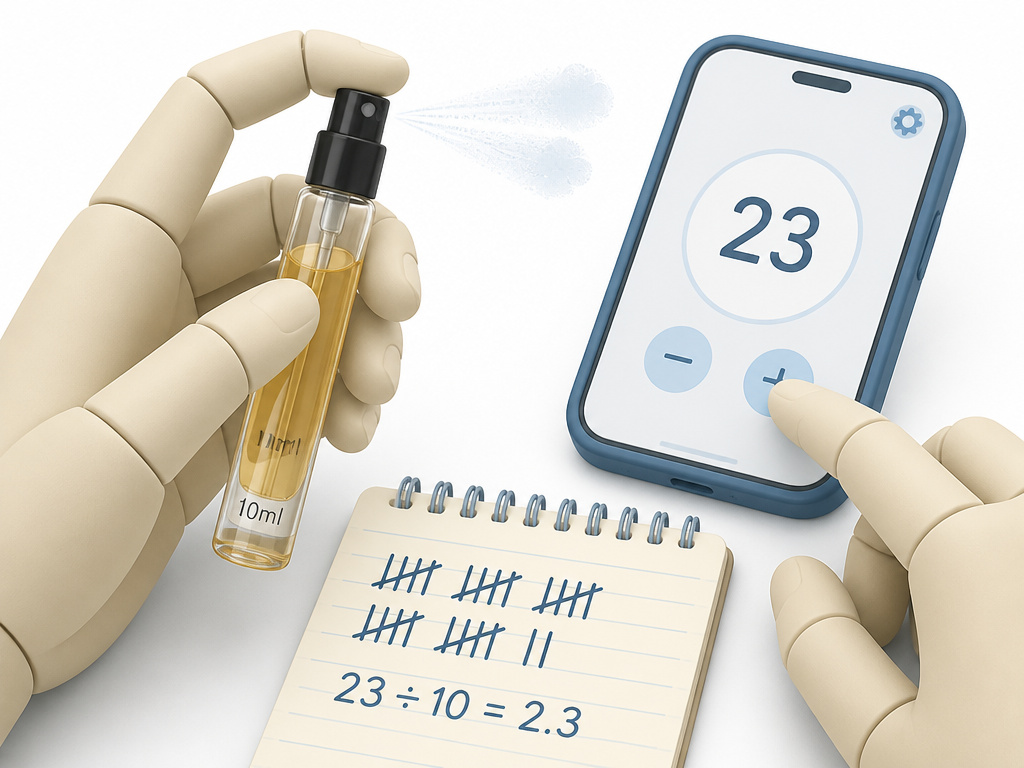
Three things: count, write it down, divide.
DecantGems makes the same argument, and it is the most useful line in their whole guide. The most reliable figure is your own. Count the sprays from the first vial you finish, and next time you will know your pace better than any rule of thumb can tell you.
- Pick one vial and one fragrance. Do not mix scents across the count, because concentration changes how many presses you actually use per wear.
- Tally every press on your phone, not in your head. You may lose count partway through, and a lost count means starting over.
- Stop when the spray turns weak and spattery. That is the dead volume talking, and it typically arrives before the vial looks empty.
- Divide your total by the number of wears. That gives you sprays per wear, which is the number that actually predicts how long your next decant will last.
My own three counts came in between roughly 90 and 120 sprays from a full 10ml. I now plan on 100 and treat anything above that as a bonus. Short version: your number beats their number.
Is a 10ml Decant the Right Size for You?
Buy the 10ml after you have decided you like the scent, not before.
That is a sizing opinion, and it runs against how most people shop. Fragrance ADDX lays out the tiers cleanly: 1 to 2ml is for a first impression, 5ml is the sweet spot for proper evaluation across different days and moods, and 10ml is for fragrances you already know you like and want to wear regularly.
- 2ml for a blind test. 20 to 30 sprays is enough for a few wears in different weather. It is not enough to learn a drydown.
- 5ml for real evaluation. 50 to 80 sprays covers multiple occasions without committing you to a scent you may tire of by week three.
- 10ml for a known like. 100 to 150 sprays is a travel supply, not a test.
- 30ml and up only after a year of regular wear. A 30ml bottle is a commitment, and a 50ml bottle is a bigger one.
If you are still weighing formats, the decant size guide walks through the trade-offs by goal rather than by volume. My own rule is boring and it works: buy the smallest size that still gives you enough wears to judge, then move up only after a year.
Store it upright in a drawer, away from sunlight, heat, and humidity. Smellion notes that decant atomizers are airtight by design, so the failure mode is temperature and light rather than air. A bathroom shelf in summer will flatten a citrus opening faster than you would believe.
Frequently Asked Questions
Is 150 sprays realistic for a 10ml decant?
Only on a fine-mist atomizer with light presses. DecantX publishes about 150 for its own 10ml Premium Atomizer, and Decant Direct publishes 140 to 160. OSMODI’s 80 to 120 range is the counterweight. If your atomizer runs wet, plan lower.
Why does my decant look half empty?
It probably is not. DecantX and Decant Direct both state that a small air gap is left intentionally for pressurization and thermal expansion during shipping. Decant Direct measures each fill with a syringe in milliliters rather than filling to the brim.
Does pressing harder give me more fragrance per spray?
DecantGems says a long, firm press gives fewer sprays from the same liquid, meaning more liquid per press. Smellion confirms that spraying style affects output but does not publish a direction. DecantGems states a directional rule while Smellion says style affects output without a direction, so they disagree on both the direction and the size of the effect.
How many wears will a 10ml decant give me?
Published answers range from 26 to 40 wears (OSMODI, at three sprays per wear) to 33 to 50 days (DecantGems, at three sprays a day) to 8 to 12 weeks (Fragrance ADDX, at four to five wears per week). The unit differs more than the arithmetic does.
Should I count sprays from my first vial or trust the table?
Count it. DecantGems recommends exactly that, and it is the only figure that accounts for your atomizer, your press force, and your dead volume. A tally settles the question permanently.
The Bottom Line
Here is the threshold that matters. If your own count from a full 10ml comes in under 80 sprays, your atomizer is running wet and you should plan on fewer wears than the higher published estimates promise. If it comes in over 130, you are holding a fine-mist nozzle and the higher estimates may apply to you.
That single number, measured once, replaces every range given here.
The other thing worth doing this week: check whether your decants are sitting in a bathroom. Move them to a drawer. Heat and humidity do more damage to a fragrance than a slightly wet atomizer does, and it costs you nothing to fix.
Start small and stay curious. A 10ml you actually finish teaches you more about your own spraying habits than a full bottle you never count.
