
How Long Does a 50ml Perfume Bottle Last? The Real Math
This post contains affiliate links. As an Amazon Associate, we earn from qualifying purchases.
A 50ml perfume bottle lasts roughly four to eight months at three sprays a day, because a 50ml bottle holds somewhere between 385 and 750 sprays depending on how the pump is calibrated.
That spread is the whole story. Two bottles with identical labels can differ by hundreds of sprays, so any single “a 50 ml lasts six months” figure is a planning number rather than a measurement, and how long does a 50ml perfume bottle last is decided by your pump.
What follows: the published spray counts and who measured them, the pump math that explains the gap, how rotation rewrites the calendar, and the point where a bottle stops being perfume.
Key Takeaways
- 416 to 750 sprays is the honest range for a 50 ml bottle, and the label tells you nothing about which end you’ll get.
- Three sprays a day puts you at four to eight months. Five sprays a day drops it to three or four.
- Rotation is the biggest lever. Five bottles worn one per weekday stretch each 50 ml to 18 to 30 months.
- Citrus turns first. Hesperidic compositions can lose top-note brightness in 12 to 18 months.
- The last 5 to 10 percent (2.5 to 5 ml) often can’t be sprayed at all. Decant it before you lose it.
The 415-to-750 Spray Spread, and Why Nobody Agrees
Six published figures for the same 50 ml bottle land between 416 and 750 sprays. The gap is nearly twofold, and the juice has nothing to do with it.
Perfume atomizer output is not standardized. Published figures for a 50 ml bottle run from roughly 416 sprays at a heavy 0.12 ml dose to 750 sprays at a fine 0.07 ml dose. A 2008 water-filled test measured 735 sprays per 50 ml bottle. Concentration changes scent strength, and spray volume stays the same.
The most careful number I’ve found is also the oldest. In August 2008, Now Smell This filled three empty 50 ml bottles from three different houses with water and sprayed each one to empty. The average came out at 735 sprays.
Water behaves differently from alcohol-based juice, though. Viscosity and evaporation both change, so treat 735 as a reference point rather than a promise.
Here’s how the published figures stack up.
| Source | Sprays per 50 ml | How it was reached |
|---|---|---|
| Now Smell This (2008) | 735 | Three bottles, water-filled, sprayed empty |
| ELOREA | ~750 | Brand’s own product figure |
| thotslifed.com | 385-714 | Calculated across nozzle outputs |
| Osmetheca | ~500 | 0.1 ml per spray benchmark |
| Wangiworld | ~500 | Packaging supplier estimate |
| Aodhy | ~500 | 10 sprays per ml |
Look at which numbers cluster. The brand figure and the empirical test sit high, at 735 to 750. The packaging suppliers and the calculators sit near 500, because they assume a 0.1 ml dose.
Which is right? Both. A fine French nozzle at 0.07 ml genuinely gives you 714 sprays from 50 ml. A heavier pump at 0.12 ml gives you 416.
How Many Sprays Does a 50ml Bottle Actually Hold?
The answer changes the moment you know your pump’s output. Divide 50 by the milliliters per spray and you have your real number.
Most perfume atomizers sit between 0.07 and 0.10 ml per actuation, with 0.1 ml as the common planning benchmark, according to thotslifed. Osmetheca puts the average at 0.1 ml but notes pumps running from 0.07 to 0.15 ml.
One outlier is worth flagging. Lom Glassworks cites an industry average of 14 to 15 sprays per milliliter, which works out to roughly 0.067 ml per spray. That’s the fine-mist end of the range, not the middle.
| Pump output | Sprays in 50 ml | Sprays in 100 ml |
|---|---|---|
| 0.07 ml (fine mist) | ~714 | ~1,429 |
| 0.10 ml (benchmark) | ~500 | ~1,000 |
| 0.13 ml (heavy spray) | ~385 | ~769 |
You can feel the difference before you count it, and it explains how long does a 50ml perfume bottle last. A fine pump lands as a dry veil that’s almost invisible on the wrist. A heavy one leaves a visible wet patch.
The same spray count math applies to a 10 ml decant, where a single milliliter is a meaningful share of the bottle.
The Scale Method for Your Own Bottle
Guessing from the table is fine for planning. Measuring takes ten minutes and settles it.
- Weigh the full bottle on a precise scale. A kitchen scale usually isn’t precise enough, and a small error throws the whole result.
- Spray it a set number of times into a cloth or the air, counting every press. Partial presses dispense partial doses, so commit to each one.
- Weigh again and divide the loss by the number of sprays. That’s your grams per spray.
- Divide 50 by that number. Skip this and you’ll keep planning around someone else’s pump instead of your own.
Grams aren’t milliliters exactly, since perfume is ethanol-rich and density varies. For planning purposes the error is small enough to ignore.
Why Three Sprays a Day Means Four Months for One Person and Eight for Another
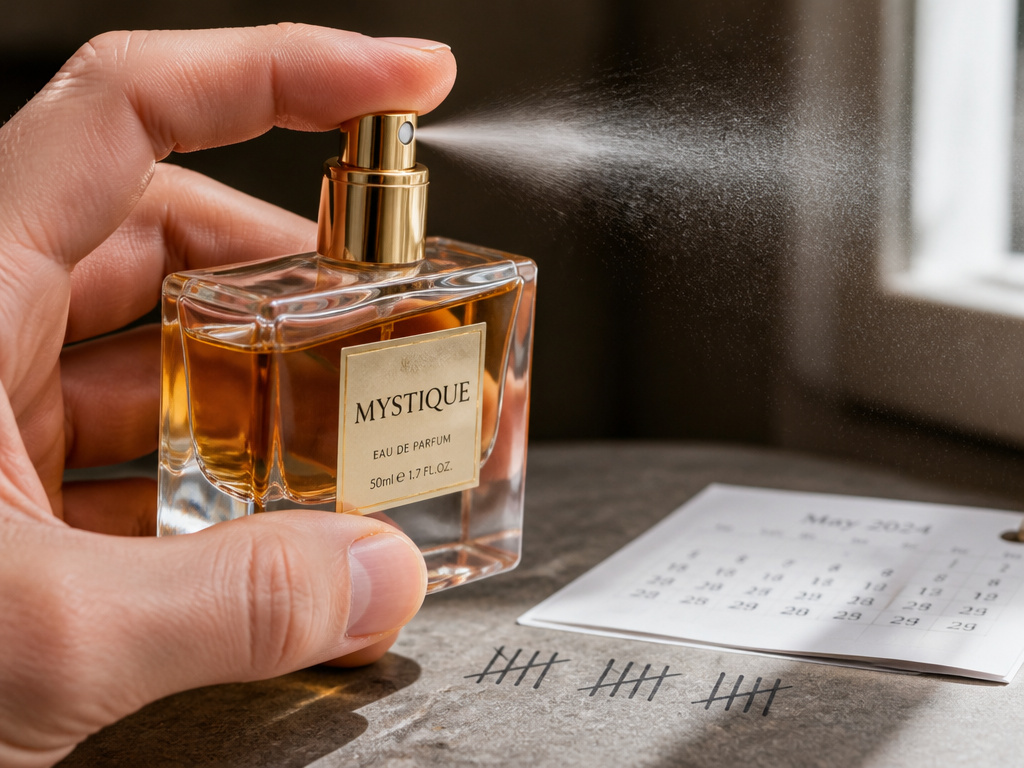
You spray twice before work, once at lunch, once before dinner. That’s four presses, not three, and it moves you a full two months down the calendar.
The published daily-use estimates overlap without agreeing:
- Osmetheca: just under 6 months at 3 sprays a day, about 4 months at 4.
- Aodhy: 4.5 to 7 months at 3 sprays a day, 3 to 4 months at 5.
- Lom Glassworks: 6 to 8 months at 2 to 3 sprays a day.
- Now Smell This: a full year at 2 sprays a day, two years at 1.
- thotslifed: about 8 months at 2 sprays a day, about 4 at 4.
Every one of those assumes a different pump, which is why the ranges slide.
Concentration Changes the Spray Count, Not the Spray Size
An eau de parfum and an eau de toilette in the same bottle with the same atomizer dispense the same volume per press. What changes is how many presses you need.
Osmetheca’s per-wear counts: an extrait at 25 to 30 percent asks for 1 to 2 sprays; an EdP at 15 to 20 percent, 2 to 4; an EdT at 8 to 12 percent, 3 to 5; a cologne at 3 to 5 percent, 4 to 6 plus reapplication.
ELOREA’s product FAQ puts their eau de parfum at a minimum of 20 percent fragrance oil and four to six hours of wear. Creed’s own FAQ lists their EdPs between 10 and 40 percent essential oils, which is a much wider band.
The net effect: a 50 ml extrait can deliver as many wears as a 50 ml EdP. A 50 ml cologne usually delivers fewer, because the low concentration invites generous spraying.
I noticed this with solid perfume before I understood the arithmetic behind it. One fingertip swipe across the tin, dabbed on each wrist, and I’m done. With a spray I used to do four or five pumps and then wonder why my coworker leaned away. Same fragrance category, half the product.
Fair warning on solids: projection is quiet, and most I’ve tried fade to a skin scent quickly. I reapply at lunch. There’s no sillage trail to speak of.
Skin chemistry adds another 20 to 30 percent of variation, per Osmetheca. Dry skin holds less fragrance and tempts you to spray more, which is the double hit.
Rotation Math: What a 50ml Bottle Lasts When It Isn’t Your Only Bottle
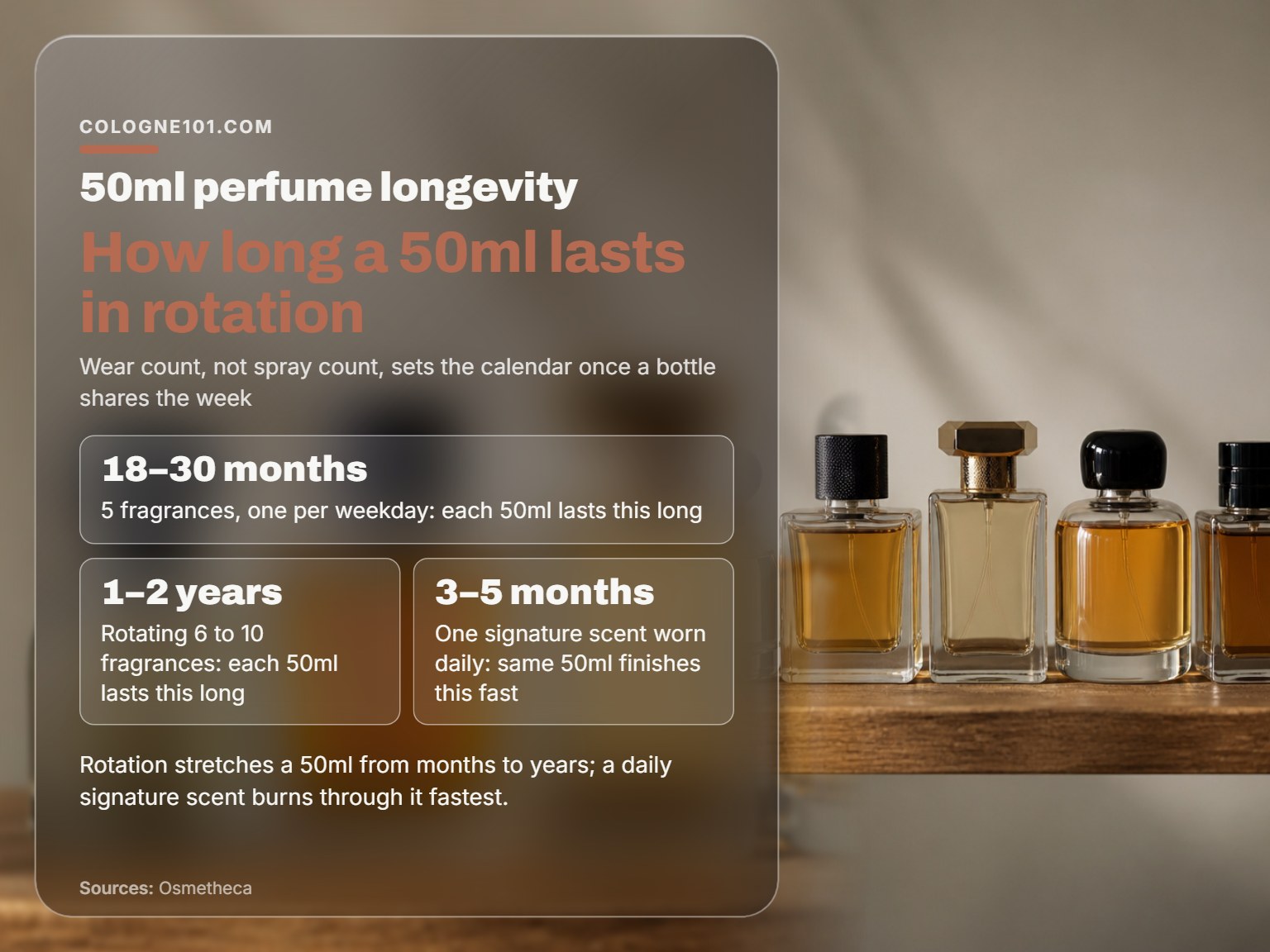
Rotation math starts with a wear count, not a spray count. Once a bottle shares the week with others, the calendar stretches fast.
Osmetheca’s figures: a wearer with five fragrances, one for each weekday, uses each bottle 50 to 75 times a year. A 50 ml in that rotation lasts 18 to 30 months. A niche enthusiast rotating 6 to 10 fragrances gets 1 to 2 years from each 50 ml.
A signature wearer is the opposite case. One fragrance every day means the same 50 ml disappears in 3 to 5 months.
So the honest answer to how long does a 50ml perfume bottle last depends on how many bottles are open on your shelf right now. Rotation changes the bottle size that makes sense for you, because a bottle sitting in a drawer is aging whether or not you spray it.
Rule of thumb: Buy the size that matches your rotation, not your enthusiasm. A 100 ml makes sense for a signature scent and turns into an expensive experiment for anything else.
I’ve watched my own shelf grow over a couple of years. The larger-collection version of me finishes almost nothing, which is the entire argument for buying small.
Does a 50ml Bottle Go Bad Before You Finish It?
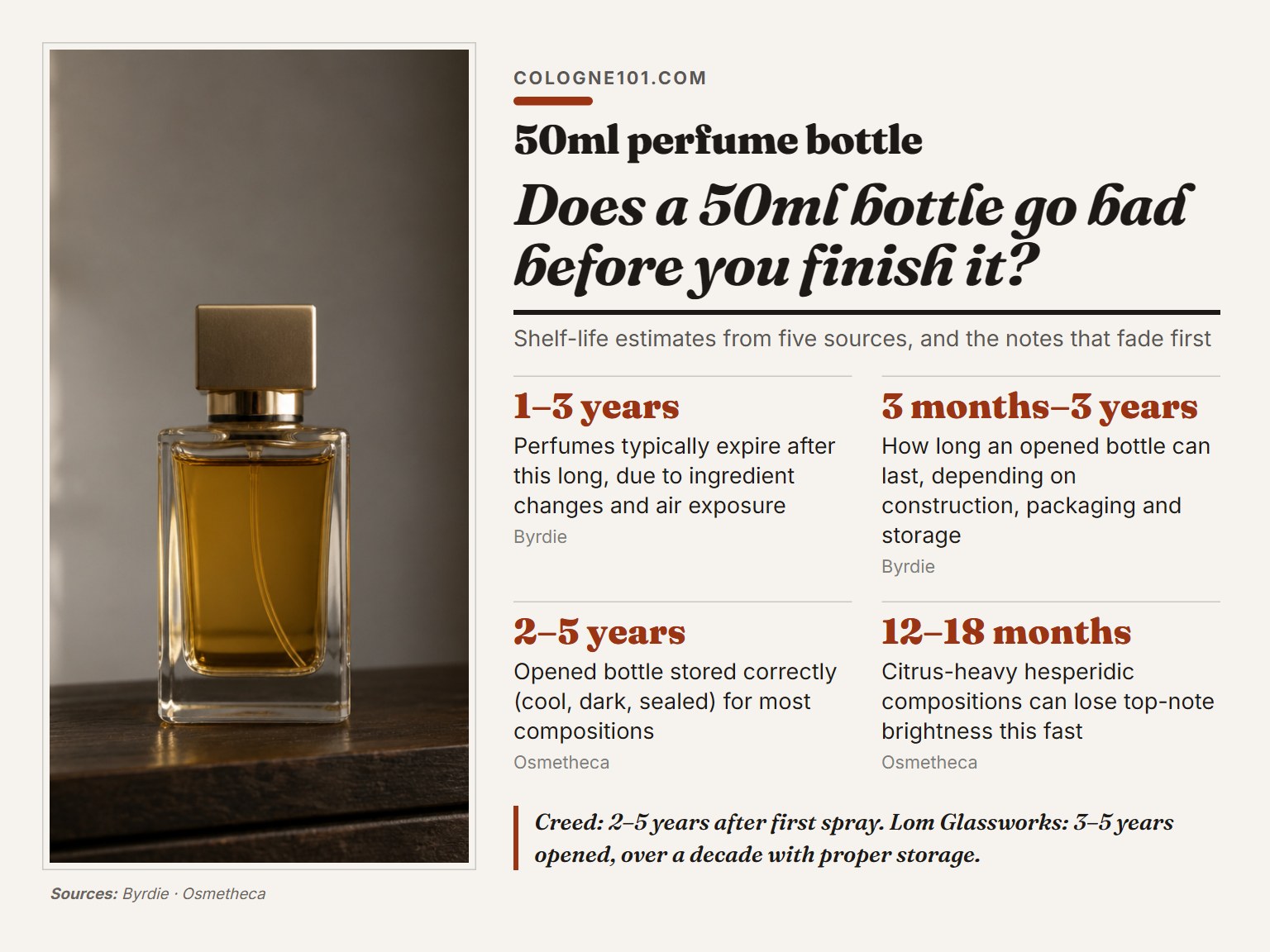
A 50 ml you never finish isn’t a bargain at any concentration. This is the question that decides whether a small bottle is smart or wasteful.
The shelf-life figures disagree more than the spray counts do:
- Byrdie: perfumes typically expire in one to three years; an opened bottle lasts three months to three years depending on construction, packaging and storage.
- Osmetheca: 2 to 5 years for most compositions, stored correctly.
- Creed: 2 to 5 years after the first spray, kept from UV light and heat.
- Lom Glassworks: 3 to 5 years after opening, over a decade with proper storage.
- ELOREA: five years.
You’ll smell it turning before you see it. Amandine Pallez of Bvlgari Parfums describes oxidized perfume as sour, sometimes acidic or metallic, sometimes carrying a note of plastic. The brightness goes first.
Citrus is the fast case. Hesperidic compositions can lose top-note brightness within 12 to 18 months, per Osmetheca. Woody and amber notes are far more stable, and some heritage extraits stay excellent at 10 to 20 years.
The part nobody mentions: Alcohol is the preservative. Pallez puts fragrance at 70 to 90 percent alcohol, and the less concentrated the juice, the better its shelf life tends to be. A light cologne can outlast a heavy extrait in the bottle.
Where the Storage Advice Actually Disagrees
Everyone agrees on the basics: cool, dark, away from sunlight and heat. ELOREA, Creed and Wangiworld all say some version of it, and Wangiworld adds the practical one, which is to keep the cap on and slow evaporation.
The fridge is where they split. Pia Long of Olfiction recommends storing citrus-based scents in the fridge to slow oxidation. Pallez qualifies it: the fridge isn’t perfect if the whole family keeps opening the door and lighting up the inside.
Pallez also gives the only hard number I’ve found in any of these sources. Keep fragrance below 15°C or 59°F.
The bathroom is the one place both named experts rule out, and Wangiworld agrees. Humidity and temperature swings from a shower are the opposite of what you want. A full storage routine matters most for a bottle you’ll take two years to finish, and the shelf life question is a different clock entirely for a bottle still in its box.
Where this goes sideways: Storing a bottle in the bathroom “just for now.” Two summers of shower steam is enough to strip the top notes off a citrus, and you won’t notice until the bottle is half empty.
Byrdie’s reporting on fragrance expiration is the source for most of the expert quotes above, and it’s worth reading in full if you want the chemistry side.
The Last 5 to 10 Percent You Never Spray
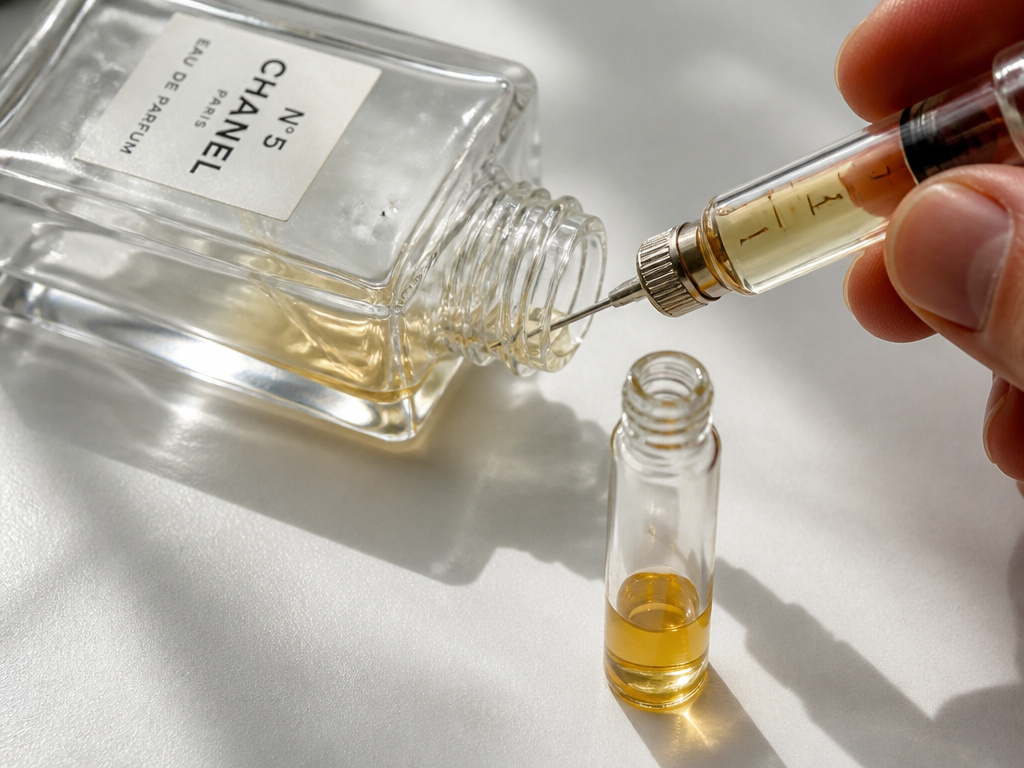
The last few milliliters are the most expensive perfume you own. The dip tube can’t reach them.
Osmetheca puts the unreachable residual at 5 to 10 percent of a bottle, roughly 2.5 to 5 ml in a 50 ml format.
The fix is a syringe or a pipette and a small sample vial. Draw off the remainder and apply it by dropper or fingertip.
Pia Long makes the related point: the more oxygen above the juice, the faster it oxidizes, so hoarding the last drops of a favorite works against you. Once a bottle is mostly air, decant it into a travel spray and use it. The same logic drives how much evaporation quietly takes over a bottle you leave half full for years.
Common mistake: Putting a prized bottle away to “save it.” A half-empty bottle with a big air gap ages faster than one you’re actively using, and the top notes are the first thing you lose.
I did this with a citrus I loved. Left the last centimeter in the bottle for a year because it felt too good to finish. When I finally sprayed it, the opening had gone flat and slightly sharp. Short version: use the bottle.
50ml vs 100ml vs 30ml: Which Size to Buy
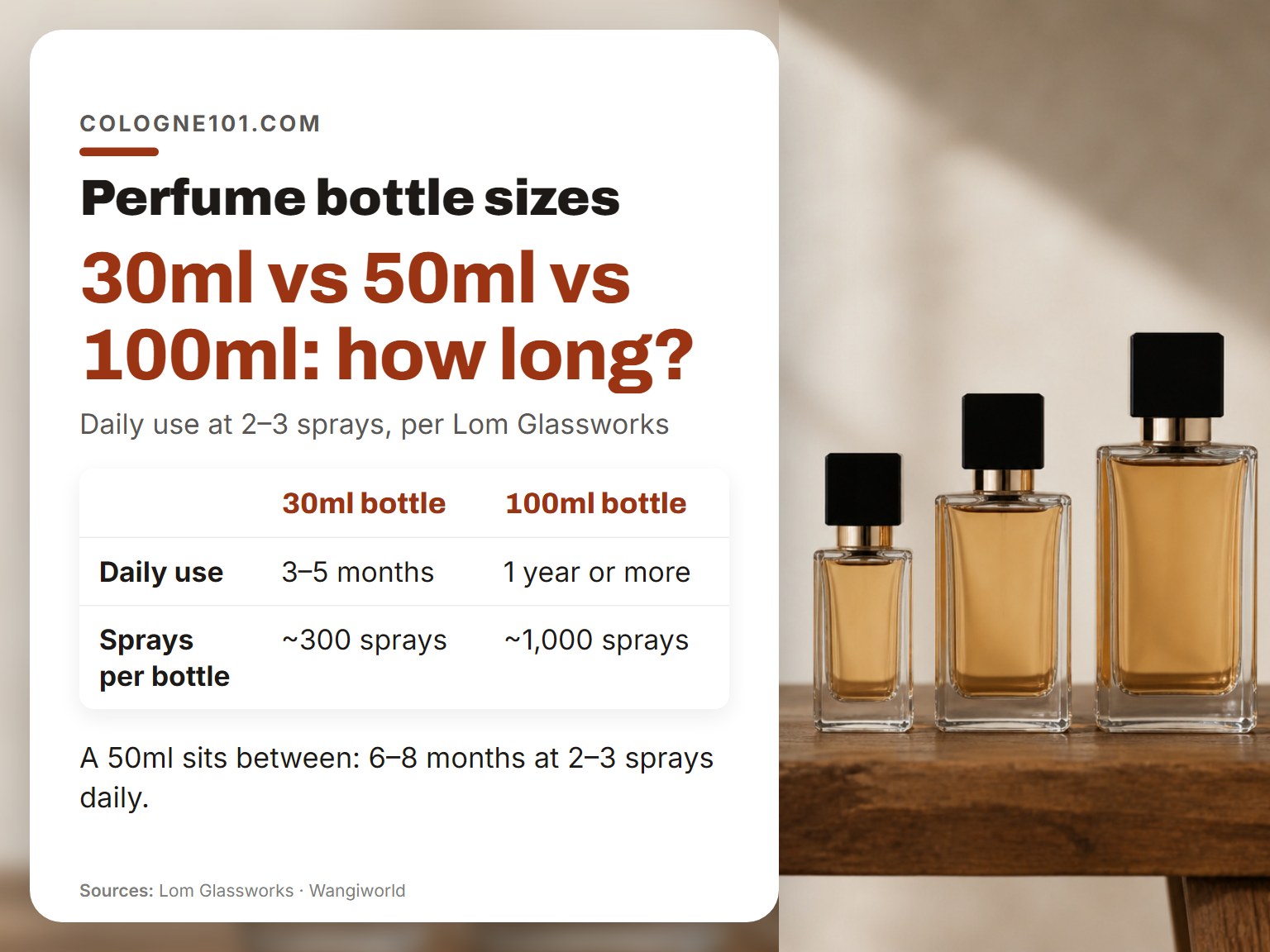
The 100 ml is the wrong bottle for most beginners. It saves money per milliliter only if you finish it before the juice turns, and most people don’t.
Run the arithmetic. A 100ml bottle holds roughly twice the sprays of a 50 ml, so at three sprays a day you’re looking at eight months to a year and a half depending on the pump. That’s a long commitment to something you’ve worn twice.
The 30ml bottle is the honest starter size. Lom Glassworks puts a 30 ml at 3 to 5 months with daily use at 2 to 3 sprays, which is long enough to learn whether you actually like the drydown.
A seasonal citrus is the clearest case for going small. A bright, hesperidic scent lives inside that 12-to-18-month window, so a 30 ml you finish beats a 100 ml you don’t.
If you’re set on one large bottle, make it a woody or amber composition. Stability is what you’re buying when you buy volume.
Creed is the counter-case worth understanding. Creed’s own FAQ puts their EdPs between 10 and 40 percent essential oils, a band running well above the 15-to-20-percent EdP benchmark Osmetheca uses for its 2-to-4-spray estimate. Higher oil load, fewer presses per wear.
Here’s the commitment: 30 ml for anything citrus or seasonal, 50 ml for a fragrance you’ve worn for a month, 100 ml only for a signature you’ve already finished a smaller bottle of. The perfume bottle sizes you see on a shelf aren’t a value ladder, whatever the price tags suggest.
Frequently Asked Questions
How many sprays are in a 50ml perfume bottle?
Depends entirely on the pump. Published figures run from about 416 sprays at a heavy 0.12 ml dose to 750 at a fine 0.07 ml dose. A 2008 test using water-filled bottles measured 735. Most planning figures land near 500 because they assume 0.1 ml per spray.
How long does a 50ml bottle last if I wear it every day?
At three sprays a day, roughly four to eight months. At five sprays a day it drops to three or four months. At two sprays a day it can stretch to a year, and at a single spray a day it can reach two years.
Does a 100ml bottle last exactly twice as long as a 50ml?
Roughly, if both come from the same house with the same atomizer. A 100 ml at 0.1 ml per spray holds about 1,000 sprays. The caveat is degradation, since a bottle you take years to finish may lose its top notes before you get there.
How long does an opened 50ml bottle stay good?
Sources disagree. Osmetheca and Creed both say two to five years for most compositions if stored correctly. Byrdie’s experts put opened bottles anywhere from three months to three years. Citrus-heavy scents are the fast case, sometimes losing brightness in 12 to 18 months.
Can I make a 50ml bottle last longer?
Two ways. Spray fewer times per wear, which a higher concentration makes easier, and store the bottle cool and dark with the cap on. Decanting the last few milliliters into a sample vial also recovers product the dip tube can’t reach.
The Bottom Line
The single most useful thing you can do this week is weigh your own bottle. Spray it a set number of times, weigh it again, divide. A few minutes gives you a number that beats every estimate here, including mine.
Then buy to that number. If you wear one fragrance daily and finish bottles, a 100 ml is fine. If you own four or more, stay at 30 or 50 ml and accept the slightly worse value per milliliter, because a bottle that turns before it’s empty costs more than the difference.
One concession: none of this matters much for a fragrance you’ll finish inside a year. The whole calculation only bites when a bottle sits half-full for years.
And if you take one thing from the sizing argument, take this. The smallest bottle you’ll actually finish is the best value on the shelf.
