
Perfume Extract vs Eau De Parfum: Which to Wear?
This post contains affiliate links. As an Amazon Associate, we earn from qualifying purchases.
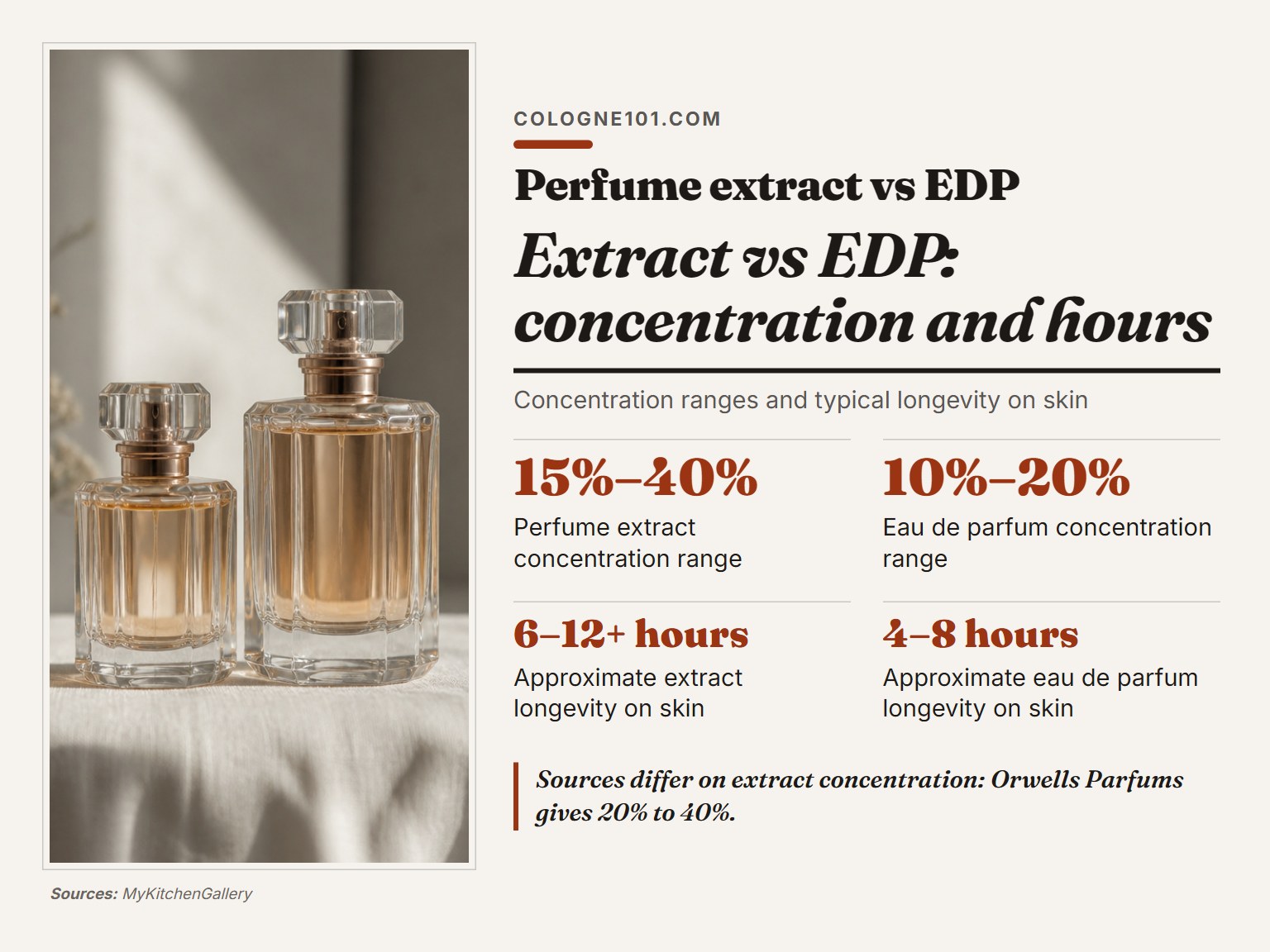
In the perfume extract vs eau de parfum choice, extract carries more fragrance oil (15% to 40% in the published ranges) and eau de parfum sits at 10% to 20%. Extract suits evenings and cold weather. EDP covers daily wear.
What follows covers what you can actually test on your own wrist: how each concentration opens, how long it holds, how much to spray, and how to store a bottle so it survives long enough to finish.
Key Takeaways
- Extract carries more oil than EDP on every published range, but the ranges themselves conflict (15% to 40% in two sources, 20% to 40% in a third).
- One spray is the working dose for extract; EL KAYAN puts EDP at two sprays and EDT at three with retouching.
- MyKitchenGallery measures extract at 6 to 12+ hours on skin and EDP at 4 to 8. That’s the only quantified longevity table in the sources, and nothing else corroborates it.
- The sources split on the opening. Orwells Parfums says extract can feel heady at first and that its pull starts with the first sprays. EL KAYAN says extract is sometimes less explosive at the start than EDP.
- Store below 77°F (25°C), away from light, and expect 5 to 10 years of shelf life when you do.
What Actually Separates Perfume Extract From Eau de Parfum
Oil load is the whole difference on paper in the perfume extract vs eau de parfum question. Everything else follows from it: how the scent opens, how long it sits, how much you spray.
An extrait de parfum carries between 15% and 40% fragrance oil according to Grasse-Atelier and MyKitchenGallery, while Orwells Parfums puts the floor at 20%. Eau de parfum sits lower, at 10% to 20% in the same two sources. No regulator or standards body publishes either band, which is why the numbers shift depending on who is selling.
Below extrait, the ladder keeps dropping. MyKitchenGallery lists eau de toilette at 5% to 15% and eau de cologne at 2% to 5%, and those two tiers behave very differently on skin. If you want the full ladder in one place, the breakdown of types of perfume covers each tier and what it’s built for.
The practical consequence is that “extract” is a rough category, not a guarantee. One house can label a bottle extrait at 15% and another can offer up to 30%, and both fit inside what the sources describe. Grasse-Atelier says its own extracts offer up to 30% of pure fragrance oils, which sits comfortably inside the 15% to 40% band it publishes for the category.
| Factor | Perfume extract | Eau de parfum |
|---|---|---|
| Published concentration | 15% to 40% (Orwells: 20% to 40%) | 10% to 20% |
| Approximate wear time | 6 to 12+ hours | 4 to 8 hours |
| Typical dose | 1 spray, or a single drop | 2 sprays |
| Best fit | Winter, evening, occasions | Daily wear, office, travel |
Read that table as a set of tendencies. The concentration column is contested, and the wear-time column comes from one source.
The Concentration Numbers Everyone Quotes Are Not a Standard
Every fragrance blog prints the same table. The table has no owner.
That matters because the ranges genuinely conflict across the sources that publish them, and the perfume extract vs eau de parfum spread is wide enough to change a decision. Here’s what each source actually says:
| Source | Extract range | EDP range |
|---|---|---|
| Grasse-Atelier | 15% to 40% | 10% to 20% |
| Orwells Parfums | 20% to 40% | Not stated |
| MyKitchenGallery | 15% to 40% | 10% to 20% |
Grasse-Atelier contradicts itself inside a single page: 15% to 40% in one paragraph, “up to 30%” for its own extracts in the next. Neither figure is certified by anyone.
When a fragrance label says extrait de parfum, it’s telling you the house chose a high oil load. It isn’t telling you a number, and it isn’t promising a wear time. The parfum vs eau de parfum breakdown goes deeper on how those two labels get used in practice.
I’ll be honest about my limits here. I can tell you how a concentration behaves on my skin over time. I can’t tell you why at the molecular level, and neither can most of the people writing these tables.
How Long Does Perfume Extract Last Compared With EDP?
So how long does the stuff actually sit on your skin?
MyKitchenGallery is the only source in this set that puts numbers on wear time: 6 to 12+ hours for parfum, 4 to 8 for EDP, 2 to 4 for eau de toilette, 1 to 2 for cologne. Nothing else in the sources corroborates those figures, so treat them as one site’s estimate rather than a measured result.
Orwells Parfums makes the same claim in words, saying extract generally lasts better than EDP or EDT and that some extracts survive a night’s sleep. It gives no hours.
Where the sources split is on the opening. Orwells says the pull begins with the first sprays and that extract can feel a little heady at first because of the concentration. EL KAYAN says extract is sometimes less explosive at the opening than EDP. Both are describing the same thirty seconds and reaching opposite conclusions.
The note structure explains part of the wear pattern. Top notes fade within 15 to 30 minutes. Heart notes run 1 to 3 hours. Base notes can hold for 8+ hours and dominate in an extract, which is why the last stretch of the day is where the difference shows up.
If you want the full picture of how long perfume lasts on skin, the variables are skin type, climate, and dose.
Test note: one spray on the left wrist, checked over several hours, with the sleeve pushed up so fabric doesn’t eat the base notes.
Why a Well-Dosed EDP Beats a Carelessly Sprayed Extract
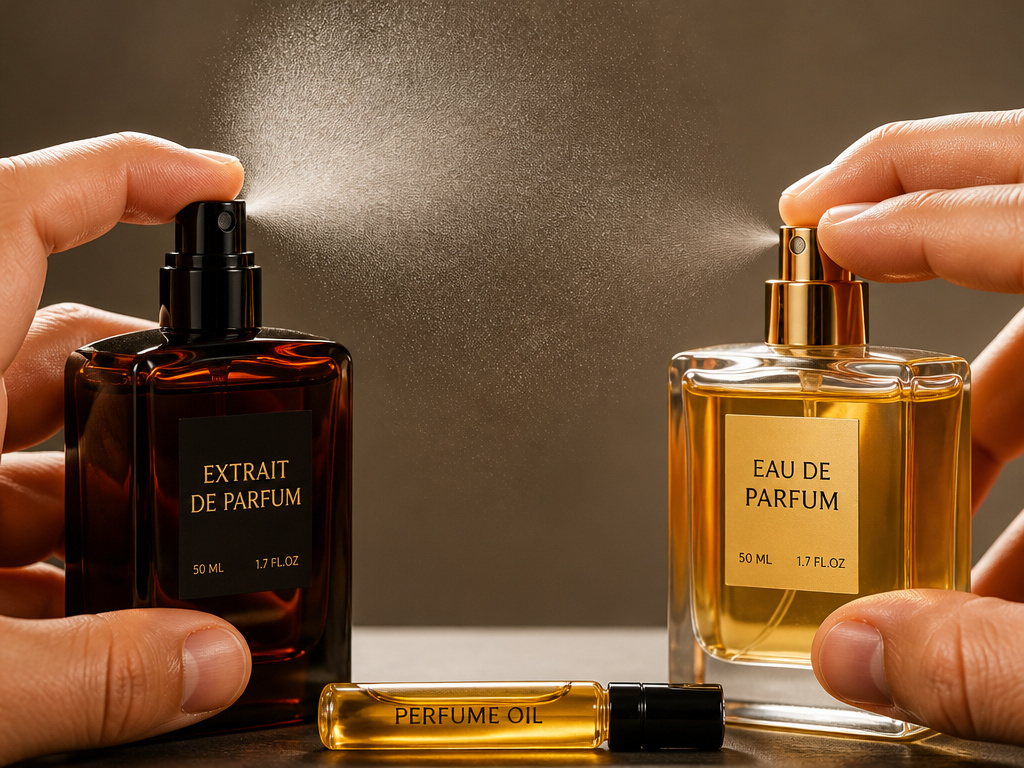
Dosage decides more than the label does.
EL KAYAN states the rule plainly: the more concentrated the fragrance, the less you spray. Extract gets one spray, EDP gets two, and EDT sometimes gets three with retouching through the day. MyKitchenGallery lands in the same place with a different unit, saying a single drop properly placed can offer all-day aroma.
Those two sources agree on the principle and differ on the measure. EL KAYAN counts sprays; MyKitchenGallery counts drops.
The 1-Spray Rule and Where It Comes From
The logic is straightforward once you accept that oil load is the variable. One spray of a concentrated extrait delivers roughly the same oil as two sprays of a lower-concentration EDP. Spraying extract like you’d spray a cologne doesn’t buy you more hours. It buys you a heavier cloud in the first hour and a headache by the third.
EL KAYAN, which sells both concentrations, argues that an EDP taken well beats a poorly dosed extract, and that a mediocre extract stays mediocre. Orwells Parfums takes the opposite line, calling extract the noblest concentration and saying it generally lasts better on skin. Both houses are describing their own shelves, and both are worth reading with that in mind.
Whether higher concentration actually buys you more hours is a separate question from whether it smells better.
If you’re deciding between the two concentrations of the same scent, buy the EDP first and wear it for a while. If you still feel shortchanged later in the day, the problem is probably dose or dry skin, and the extract won’t fix either one.
My own read is that the spray count tells you more than the label does. I’ve been disappointed more often by over-spraying an EDP than by a single spray of a mid-priced extrait.
Where to Spray, and the Habit That Kills Longevity
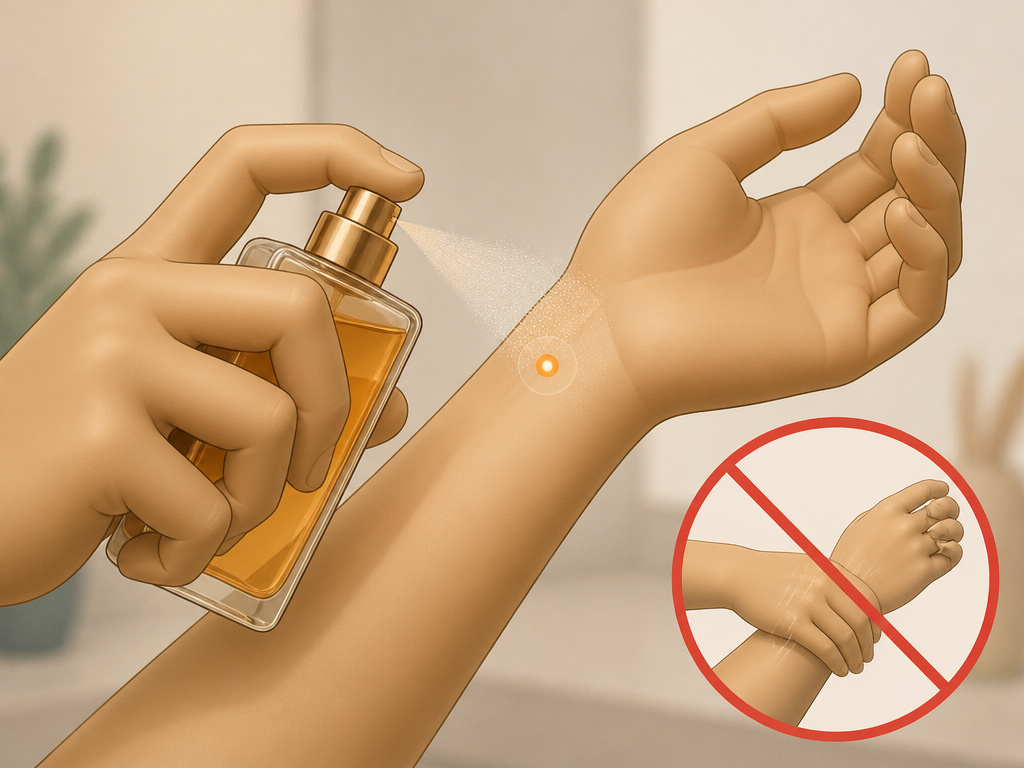
Pulse points work because body heat pushes the scent off the skin and into the air.
MyKitchenGallery names the spots: wrists, neck, and behind the ears. Body heat at those areas helps diffuse the scent, so the fragrance keeps releasing instead of sitting flat.
Common mistake: Rubbing your wrists together after spraying. Friction and heat break down the molecules, and the top notes that should hold 15 to 30 minutes collapse early. Dab if you must. Don’t grind.
Pulse Points, and Why Rubbing Ruins Them
Skin condition does the rest. Dry skin shortens the whole arc, which is why moisturizing first helps. MyKitchenGallery notes that applying over a moisturizer or an unscented body oil can significantly enhance staying power, and that layering with the brand’s matching scented lotion or oil stretches the release further.
Hair is a different surface. EL KAYAN advises keeping hair application light, and that’s the right call. Hair holds scent for a long time, and a heavy hand there turns into a room-filling cloud.
The eau de toilette vs eau de parfum split matters more in hot weather than most people admit. EL KAYAN treats EDP as the versatile daily standard, which is fair. I still reach for lighter concentrations with citrus in summer, because a high oil load flattens the brightness that made the scent worth wearing.
Storing Extract So It Survives Heat, Light, and Time
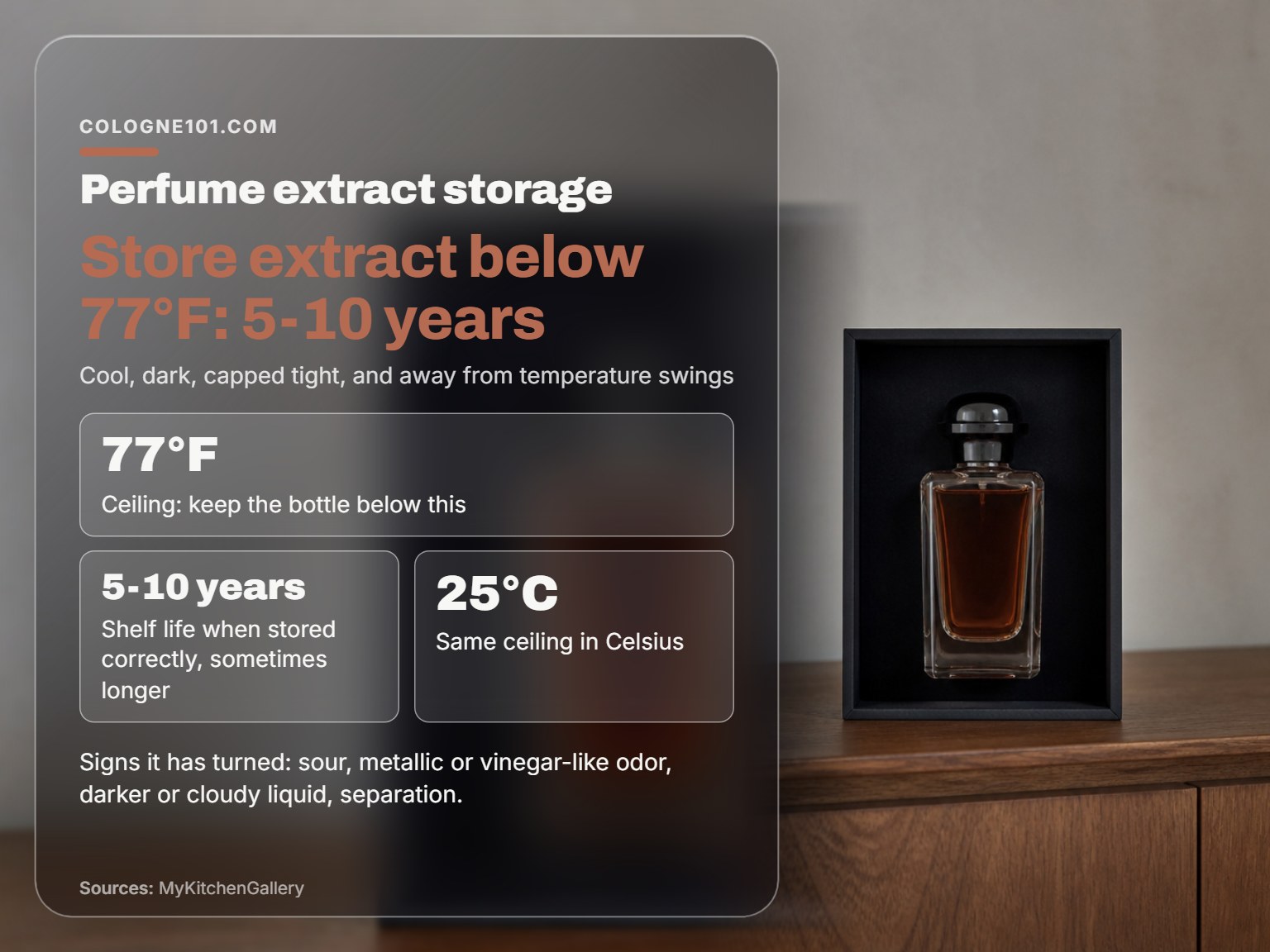
77°F is the ceiling. Keep a bottle below that, in the dark, and MyKitchenGallery puts its shelf life at 5 to 10 years, sometimes longer.
The rules are short and most people break all of them:
- Keep it cool and dark. A box or a cabinet, ideally below 77°F (25°C).
- Skip the bathroom. Heat and moisture swing wildly in there.
- Shield it from UV. Light degrades fragrance compounds, which is why the original box exists.
- Close the cap tight.
- Avoid temperature swings. No cars, no radiators, no windowsills.
The Three Signs a Bottle Has Turned
You’ll smell it before you see it. MyKitchenGallery lists a sour, metallic, or vinegar-like odor as the first sign of oxidation. Then the look changes: the liquid darkens or turns cloudy, and the ingredients can separate.
Natural oils go first. MyKitchenGallery notes that essential oils like bergamot, rose, and sandalwood degrade faster than synthetic aroma chemicals like ambroxan and muscone, which is why a house blends both.
Which One Should You Actually Buy?
A friend of mine spent a long time telling anyone who’d listen that perfume gave her headaches. She’d tried a few bottles, all gifts, all strong. Then she tried a lighter concentration on one spot on her wrist, wore it to dinner, and nothing happened. She wears fragrance most weekends now. Strength was the problem, not scent.
That’s the decision in miniature, and it’s why I’d rather see you test than upgrade.
EL KAYAN lays out the order to work through before you pay for an extract. Dose first. Hydration second. Layering third. A denser bottle fourth. If density is still missing after all four, change the profile toward amber, gourmand, or a dense floral before you change the concentration.
Here’s what that looks like as a checklist:
- Recheck your dose. Two sprays of EDP instead of one is free.
- Moisturize first. Dry skin burns through fragrance faster.
- Layer a musky base. EL KAYAN notes this can beat a single extract.
- Try a denser profile. Amber and gourmand hold longer than citrus.
How to Test Before You Commit
- Spray one concentration on each wrist, not on paper. Paper tells you only what a scent smells like briefly.
- Wait before you judge. Top notes are gone by then and the real structure is showing.
- Check later in the day. That’s where EDP and extract separate, if they’re going to.
- Wear the winner again before you buy a full bottle.
Several houses make this easy because they sell the same scent in both forms. Les Fleurs du Golfe Night Flower is a straight extract in a 50 mL bottle if you want a single-concentration reference point.
Understanding how concentration affects perfume price is worth ten minutes before you decide the extract is the upgrade.
Give it a few hours before you decide. A scent that feels thin at minute ten is often just early.
Frequently Asked Questions
Is perfume extract stronger than eau de parfum?
On every published range, yes. Grasse-Atelier and MyKitchenGallery put extract at 15% to 40% and EDP at 10% to 20%. Orwells Parfums sets the extract floor higher, at 20%. Stronger in oil load doesn’t automatically mean louder in the room, though, because dose and skin chemistry both intervene.
How many sprays of perfume extract should I use?
EL KAYAN says one. MyKitchenGallery describes a single drop as enough for all-day wear. Two sprays of a concentrated extrait delivers roughly the oil load of several sprays of a lower-concentration EDP, which is why people who spray extract like cologne end up overwhelmed by lunchtime.
Does perfume extract last longer on skin?
Orwells Parfums says it generally does and that some extracts survive a night’s sleep. MyKitchenGallery puts a number on it: 6 to 12+ hours for extract against 4 to 8 for EDP. That table is the only quantified source here, so treat the hours as a rough guide.
Why do sources disagree about concentration percentages?
Because no standards body defines the tiers. The International Fragrance Association regulates restricted ingredients, not oil load, and ISO 1998 covers essential oil vocabulary. Without a definition, each house and retailer publishes its own range, and the ranges don’t match.
Can I store perfume extract in the bathroom?
No. MyKitchenGallery specifically warns against it, because heat and moisture fluctuate constantly in a bathroom. Store it in a dark cabinet below 77°F (25°C), away from windows, radiators, and cars.
What does expired perfume extract smell like?
Sour, metallic, or vinegar-like. MyKitchenGallery also lists darker or cloudy liquid and ingredient separation as signs the bottle has turned. Natural oils such as bergamot and rose degrade before synthetic aroma chemicals do.
The Bottom Line
If you’re standing in a shop deciding, buy the EDP first. Wear it for a full day and note where it fades. Most people who think they need an extract are under-spraying or spraying onto dry skin.
The threshold that flips it: if two sprays of EDP on moisturized skin still fades early, and you’ve already tried a denser profile, then the extract is worth testing. Below that, you’re paying for oil you don’t need.
One concession, because it’s true. I test on my own skin, so my read on performance in real heat or on very dry skin is weaker than it sounds. Your wrist will tell you more than I can.
