
How to Make Solid Perfume: Ratio, Wax and Set Time
This post contains affiliate links. As an Amazon Associate, we earn from qualifying purchases.
That ratio is the whole argument. Five published solid perfume recipes give four different wax-to-oil numbers, and the spread between them is the difference between a balm you scrape out with a thumbnail and one you can push a fingertip through. Anyone learning how to make solid perfume meets this same range.
What follows is the ratio spread laid out side by side, the cooling argument that decides whether your top notes survive, the vegan wax swap, and the three failures behind most ruined batches. By the end you’ll read any solid perfume recipe and know what firmness you’re getting before you melt a single pellet.
Key Takeaways
- Equal parts wax and oil by weight gives a firm balm that travels well, per The Perfumery Guide; four parts oil to one part wax gives a soft, scoopable one, per Crafter’s Choice and AromaWeb. Decide which you want first.
- Pull the jug off the heat and let it stop steaming before the fragrance goes in, as The Perfumery Guide advises; Crafter’s Choice instead cools to 160°F and AromaWeb cools a few moments without letting it solidify. Fragrance into hot wax loses its top notes before the tin sets.
- A 0.01 g digital scale is the only gear worth buying. Volume measures drift, and the ratio is what you’re actually controlling.
- Rest the tin before you judge the scent: The Perfumery Guide says 24 to 48 hours, while Immortal Perfumes says it smells best after sitting untouched for a week.
- Make small batches if you follow AromaWeb, which says there’s no preservative and a finger in the tin is a bacteria delivery system; wikiHow instead says sealed perfume keeps 6 to 12 months.
What Ratio of Beeswax to Oil Actually Works?
Four published recipes give four different wax-to-oil numbers, and every one of them produces a usable balm. The ratio sets firmness, and firmness is a preference, not a rule.
Beeswax sets the balm’s rigidity while jojoba stays liquid at room temperature, so the wax-to-oil ratio controls how hard the finished tin becomes. A four-to-one oil-heavy base stays soft enough to scoop with a fingertip; an equal-parts base holds a fingerprint, survives a warm handbag, and pours closer to a lip balm.
Crafter’s Choice runs 1.60 oz jojoba against 0.40 oz beeswax, which is four parts oil to one part wax. AromaWeb lands on the same 4:1 with 1/2 oz jojoba and 1/8 oz beeswax. The Perfumery Guide goes the other way entirely, an even 8.50 g of each in a 20 g batch. From Nature With Love sits between them at three parts oil to two parts wax, and Immortal Perfumes pushes hardest at roughly two parts wax to one part oil.
| Source | Wax to oil | Firmness |
|---|---|---|
| Crafter’s Choice | 1 part wax to 4 parts jojoba | Soft, scoopable |
| AromaWeb | 1 part wax to 4 parts jojoba | Soft, scoopable |
| From Nature With Love | 2 parts wax to 3 parts oil | Medium |
| The Perfumery Guide | 1 part wax to 1 part oil | Firm |
| Immortal Perfumes | 2 parts wax to 1 part oil | Very firm |
What the ratio changes, in practice:
- Firmness: how hard the surface sits in the tin, and whether a fingertip dents it.
- Travel: a firmer balm survives a warm bag without weeping oil into the lid.
- Scoopability: a soft balm lifts in one pass. A firm one wants a thumbnail.
The mechanism is simple. Beeswax is the structurant; jojoba stays liquid at room temperature. More wax means a tighter crystalline network holding less oil, and that reads as hardness in the tin. AromaWeb chose wax over shea or mango butter for exactly this reason: wax is more stable and less likely to fully melt if the tin gets left somewhere hot. Swap in butter and you’ll need to rebalance the wax and jojoba to get the rigidity back.
If you’re still deciding what the carrier should be, the how to make solid perfume carrier base is worth reading before you commit to a bottle of jojoba.
Why a 0.01 g Scale Beats Every Measuring Spoon in Your Kitchen
Buy the scale. It’s the only piece of gear this project actually needs.
The Perfumery Guide specifies a 0.01 g digital scale, and that precision matters because you’re working in a 20 g batch. A gram of extra wax in a 20 g batch is a meaningful shift in the whole formula. A teaspoon doesn’t get you there, and neither does a tablespoon, which is why the spoon-based recipes (1 tablespoon beeswax, 1.5 teaspoons jojoba) are the hardest ones to reproduce twice.
Before you start: Melted beeswax sits well above the temperature your skin tolerates, and it sticks while it burns, so keep a bowl of cold water within arm’s reach and never lift the jug by the rim. Essential oils are concentrated: a phototoxic oil like expressed bergamot can react on skin that later sees sun, so keep those off your neck and wrists before a day outside. Work on a clean surface with a dedicated jug you don’t cook with.
The Melt, Step by Step
- Weigh the wax and jojoba into a heatproof glass jug. Skip the scale and you’re guessing at the one number that decides your texture.
- Set the jug over barely simmering water and stir until no pellets remain. Wax that gets too hot smells faintly scorched, and the balm sets with a dull, grainy face.
- Take it off the heat and let it cool until it stops steaming. A minute or two. Fragrance into steaming wax loses its top notes before the tin even sets.
- Add the fragrance and stir for 20 to 30 seconds. Ten seconds leaves streaks of undiluted oil that hit one spot on your wrist and nowhere else.
- Pour into clean tins straight away, before the edges start to set. Wait too long and you get a lumpy surface you’ll have to remelt.
- Leave the lids off until the tins are completely cool, then cap them, as The Perfumery Guide advises to stop condensation; Immortal Perfumes instead says sit open 15 minutes, then close the lid once it looks hard.
The sensory cue that tells you step two is done: the pellets go from opaque ivory to clear, and the last one vanishes with a soft click against the glass. After that the jug goes quiet. If you can still hear grit scraping the bottom, keep stirring.
Crafter’s Choice fills each jar to 0.35 oz by weight rather than eyeballing the level, and that’s the right instinct. If the mixture starts to harden mid-fill, heat it briefly to liquefy and carry on.
When Do You Add the Fragrance?
Crafter’s Choice names a number: cool the melted wax and jojoba to 160°F, then add the essential oil and blend. AromaWeb says cool a few moments after removing from the heat, without letting it solidify. The Perfumery Guide says wait a minute or two until it’s still fully liquid but no longer steaming. From Nature With Love melts the wax first and blends the oil and fragrance straight in.
Four sources, four descriptions of the same moment. The sources disagree: Crafter’s Choice specifies 160°F, while AromaWeb and The Perfumery Guide describe cooling for a few moments or a minute or two until no longer steaming.
The Perfumery Guide explains the failure: fragrance added to very hot wax drives off the delicate top notes, while fragrance added too late leaves the balm lumpy. That’s the whole trade-off; The Perfumery Guide prefers “no longer steaming” as a working cue, while Crafter’s Choice specifies cooling to 160°F. You can see steam. You can’t see 160°F without a probe.
I’ve stopped chasing a number here. I pull the jug off the heat, stir once, and wait until the surface stops shimmering with heat. Give it four hours on skin before you decide the fragrance failed, because a balm that smells thin at the ten-minute mark often fills out overnight.
The fragrance load varies even more than the timing. The Perfumery Guide runs 3.00 g of fragrance concentrate in a 20 g batch, which is 15% by weight, and says you can push toward 20% if every material stays inside its IFRA limit. Crafter’s Choice uses 2.50 mL of essential oil for a 2 oz batch, closer to 4%. AromaWeb specifies 6 drops. Immortal Perfumes counts 40 drops against 1 tablespoon of beeswax.
That’s a large difference between the highest and lowest loads, and it explains a lot of “my solid perfume smells weak” complaints. If you’re building from perfume from essential oils rather than a ready-made concentrate, start at the low end and work up.
A starting blend from The Perfumery Guide, in parts by weight: lavender 30, bergapten-free bergamot 15, Virginian cedarwood 25, Iso E Super 20, Hedione 10. Scale the parts to hit the 3.00 g the 20 g batch needs. If you’ve only ever blended perfume oil, the same formula usually carries over, since both sit on an oil base.
Immortal Perfumes notes that fragrance oils are already diluted in carrier oil and tend to be less irritating than essential oils. Crafter’s Choice builds its lavender formula around Lavender 40/42, a standardized blend rather than a single oil, which is worth knowing if you’re expecting a field-fresh lavender.
Beeswax, Candelilla, or Carnauba: Which Wax Sets the Way You Want
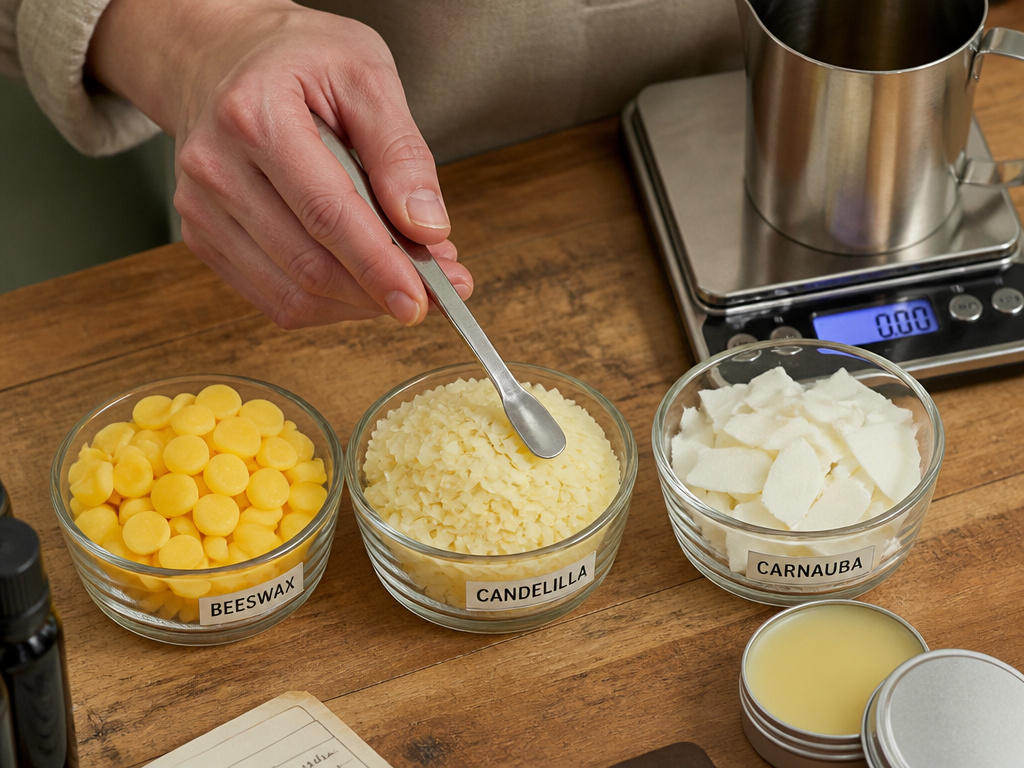
Candelilla wax sets harder and glossier than beeswax; The Perfumery Guide suggests roughly half the beeswax weight, then adjust, while AromaWeb gives no ratio.
| Wax | What it does | Watch for |
|---|---|---|
| Beeswax | Firm, slightly tacky, holds scent well | The default in most published recipes |
| Candelilla | Sets harder and glossier than beeswax | Start at half the beeswax weight, then adjust |
| Carnauba | Hardest of the three | Blend it with a softer wax, never use alone |
If You Want a Vegan Tin
The Perfumery Guide gives a conversion: candelilla at roughly half the beeswax weight, then adjust from there; AromaWeb mentions bayberry wax as a possible substitute but gives no ratio. AromaWeb mentions bayberry wax as a possible substitute but says the wax-to-oil ratio may need adjusting and gives no number. Neither source supplies a tested conversion.
That gap matters. Candelilla is harder than beeswax, so a straight substitution over-firms the balm and you end up with something closer to a lip balm than a perfume. Start low, remelt, and add more if it’s too soft.
Carnauba is harder still, and The Perfumery Guide says it should be blended with a softer wax rather than used alone. For a creamier feel, The Perfumery Guide suggests replacing a few grams of oil with shea or cocoa butter, with one warning attached: cool butters quickly or they turn grainy.
How Long Until It’s Actually Ready to Wear?
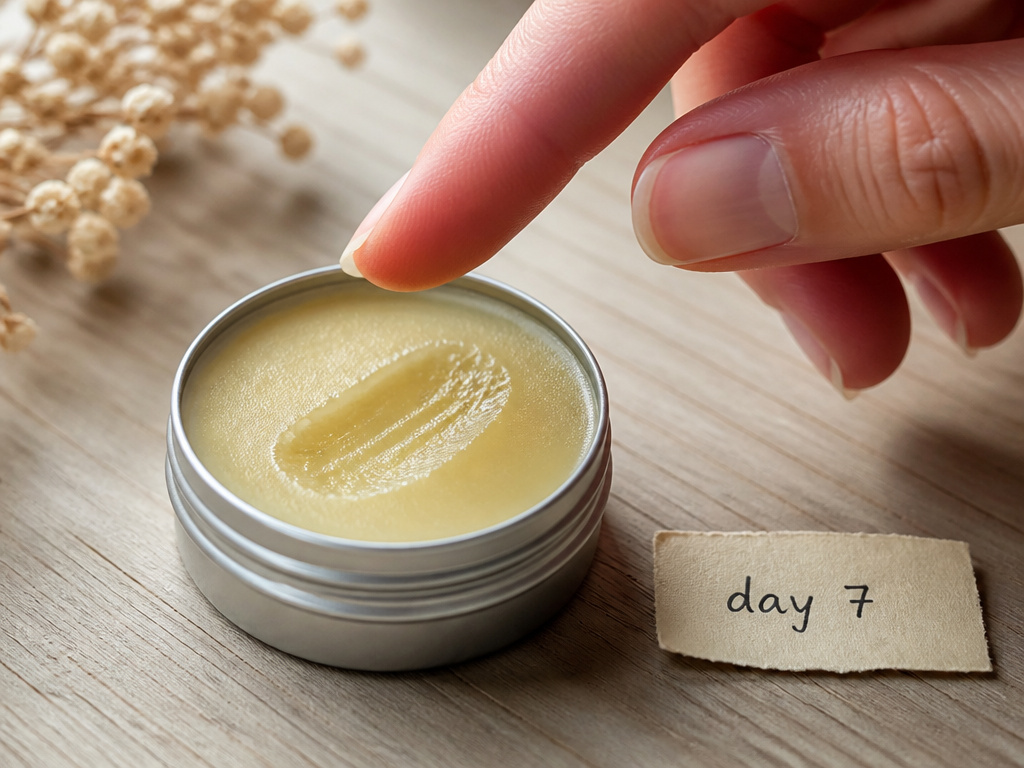
The whole how to make solid perfume project takes about twenty minutes. The waiting takes longer, and the sources disagree about how much longer.
Rest it a week if you can stand it. A balm that smells sharp and disjointed on day one usually rounds out by day seven, and you’ll have wasted a batch’s worth of judging if you dump it on day one.
Once it’s set, the wear is its own thing. The Perfumery Guide describes solid perfume as wearing close to the skin and lasting a few hours, similar to a perfume oil, projecting less than a spray. That tracks with what I’ve found: most solids I’ve tried fade to a skin scent after a few hours, so I reapply at lunch. No sillage trail, and that’s the trade.
There’s an upside I didn’t expect. A solid makes me apply less without trying. One fingertip swipe across the tin, dabbed on each wrist, and I’m done. With a spray I used to do four or five pumps and then wonder why someone leaned away.
Where you put it matters less than you’d think. Crafter’s Choice and AromaWeb both point to the neck, behind the ears, and the wrists. If you want the fuller picture on placement and reapplication, there’s a separate walkthrough on where to dab solid perfume, and the honest trade-offs are laid out in these solid perfume pros and cons.
When the Batch Goes Wrong, Fix It Instead of Tossing It
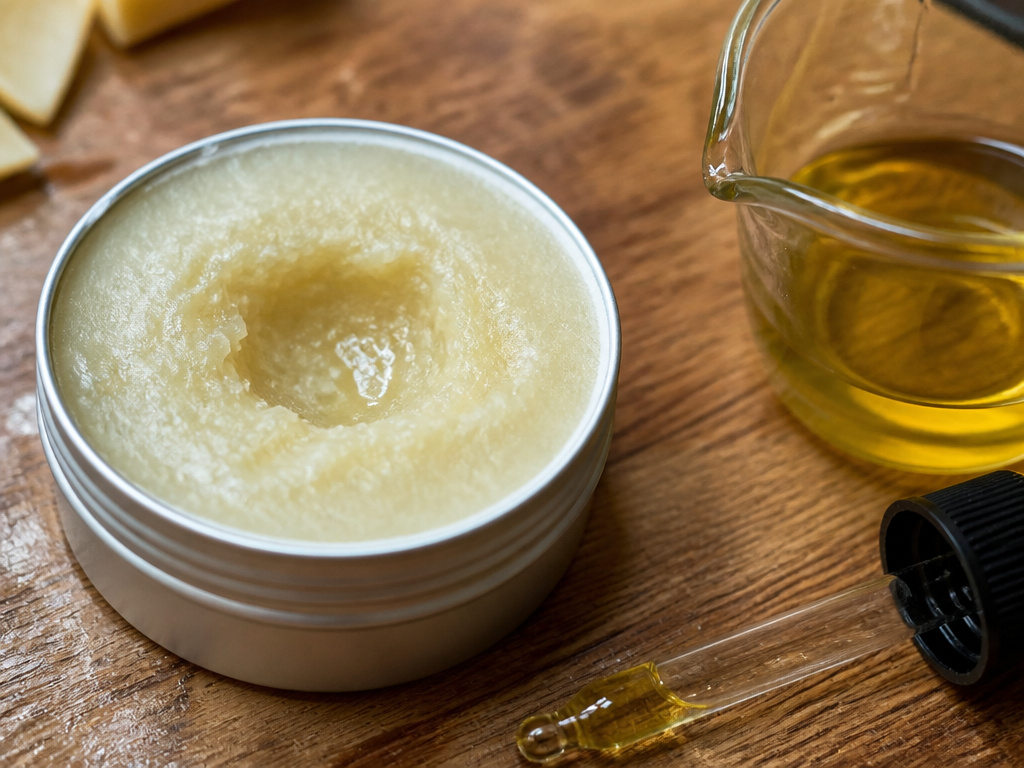
The tin looks fine at ten minutes. By morning there’s a crater in the middle and the surface has gone cloudy.
Almost every failure is fixable, because the whole thing remelts. Work through the symptom:
- Too hard or draggy: remelt and add 1 to 2 g more oil per 20 g batch.
- Too soft or greasy: remelt and add 0.5 to 1 g more wax.
- Mushy, never set: not enough beeswax. Immortal Perfumes calls this one out directly, and the fix is a remelt with more wax.
- Scent is weak: raise the fragrance toward 20% by weight, provided every material stays inside its IFRA limit, and lean on long-lasting base notes.
- Top notes vanished: the wax was too hot when the fragrance went in. Cool longer next time.
- Cracked or sunken top: it cooled too fast or unevenly. Pour slightly cooler, or top up with a little remelted balm.
Where this goes sideways: pouring into a cold tin straight from a hot jug. The wax sets at the edges first, the middle sinks as it contracts, and you get a cratered surface that looks like a failed batch even though the formula was fine.
If the scent itself is the problem rather than the texture, the fix is usually more fragrance or more rest, not a new formula. There’s a longer diagnostic linked here for a perfume smells weak batch.
AromaWeb recommends making only enough solid perfume to last one month, on the grounds that finger-swiping can introduce bacteria and the product contains no preservative. WikiHow takes the longer view: store it sealed in a cool, dry place for 6 to 12 months, with grapeseed oil shortening that to 6 months and olive, jojoba or almond oil holding to 12.
Both are right about different things. AromaWeb is talking about contamination from the finger in the tin. WikiHow is talking about the oil going rancid. Beeswax and jojoba both extend shelf life compared with fragile vegetable oils and butters, which is why the jojoba-based version outlasts a butter-based one.
Heat is the shared enemy. AromaWeb warns that hot storage can melt, leak, shorten shelf life and alter the aroma. If you want the full storage picture, this guide on how to store solid perfume covers it.
Frequently Asked Questions
Can I make solid perfume without beeswax?
Yes. Candelilla wax is the standard vegan substitute, and The Perfumery Guide’s starting point is roughly half the beeswax weight because candelilla sets harder and glossier. Carnauba wax is harder still and should be blended with a softer wax rather than used alone. Neither source supplies a tested conversion, so plan to remelt and adjust.
How long does solid perfume last on skin?
Few hours. The Perfumery Guide compares it to a perfume oil: it wears close to the skin and projects less than a spray, which makes a lunchtime reapplication normal rather than a sign of a weak batch.
Why did my solid perfume turn out mushy?
Not enough beeswax. Immortal Perfumes names this as the direct cause, and the good news is that a mushy batch isn’t ruined. Remelt it and add 0.5 to 1 g more wax per 20 g batch, then pour again.
Do I need a preservative?
None of the sources use one, and AromaWeb’s answer is to work around that rather than add something: make only enough to last about a month, because swiping a finger into the tin can introduce bacteria even with clean hands. Small batches solve most of the problem.
Can I use fragrance oils instead of essential oils?
Yes, and Immortal Perfumes notes they’re already diluted in carrier oil, which tends to make them less irritating than essential oils. Not every essential oil is skin safe, so check advisories either way. If you’re avoiding alcohol entirely, this alcohol-free perfume piece covers the wider category.
The Bottom Line
Here’s the threshold that decides your first batch: if you don’t own a 0.01 g scale, buy one before you buy wax. Everything in this project is a ratio, and a ratio you can’t measure is a ratio you can’t repeat. The second batch is where the hobby actually starts, and you only get a second batch that matches the first if you weighed things.
One more thing worth saying plainly. If you’re new to perfume making for beginners, resist the twelve-note formula. Three materials, weighed, will teach you more about how a balm carries scent than a crowded blend ever will, and you’ll actually be able to taste what each one is doing.
Your homework: weigh out an equal-parts batch tonight, 8.5 g beeswax and 8.5 g jojoba, add 3 g of a single fragrance, and leave the tin uncovered until completely cool, then lid it. Then don’t touch it for two days. Sniff it on day one and again on day three and you’ll understand the rest period better than any recipe can explain it.
